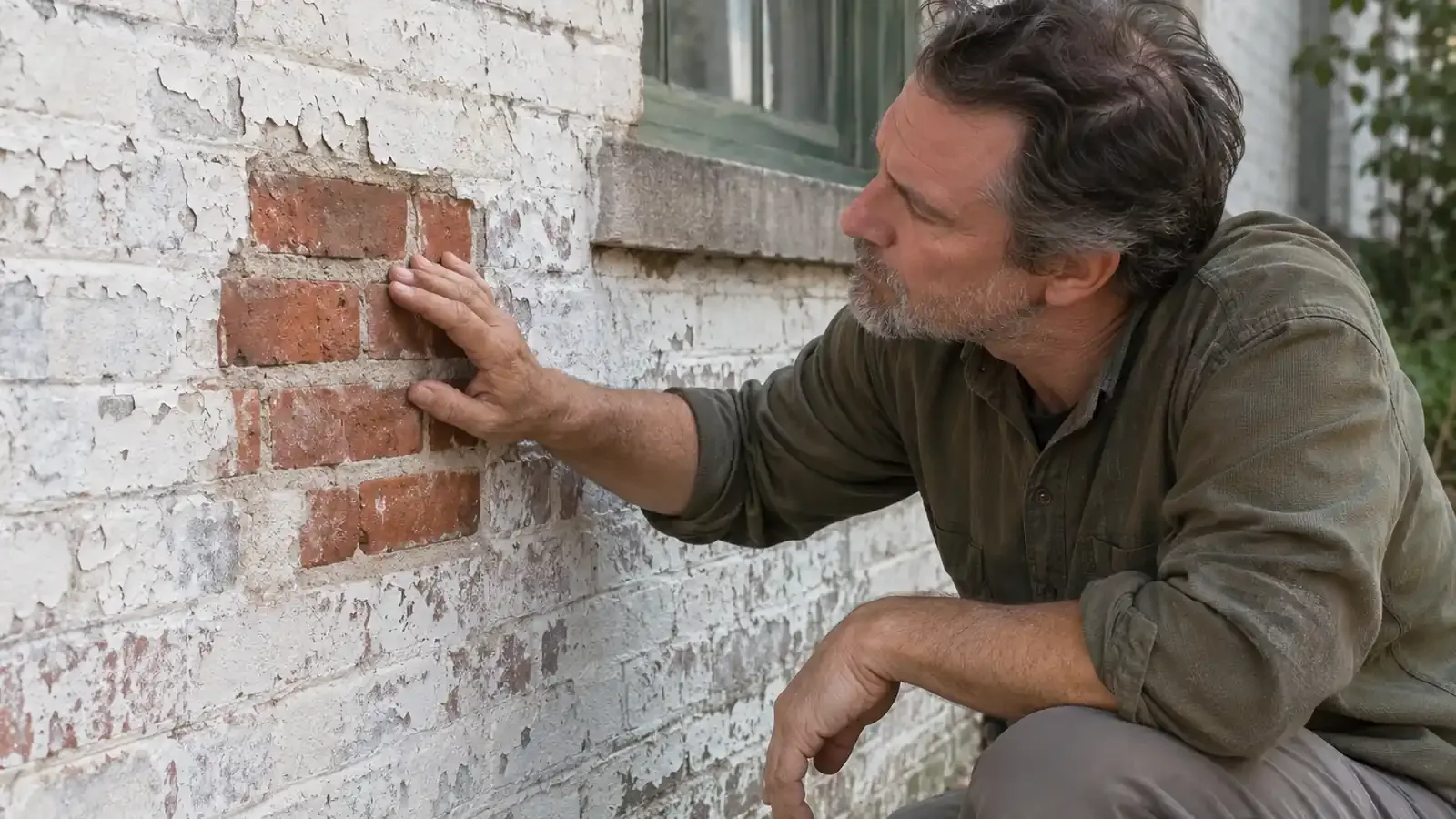
Sandblasting can remove paint from brick, but successful paint removal does not prove the process was safe. The same abrasive stream that cuts through a coating can also erode the fired face of a brick, deepen its texture, round its edges, and remove mortar from the joints.
For historic brick, soft or weathered masonry, glazed or coated units, and walls with weak mortar, conventional sandblasting is generally not an appropriate choice. A sound modern wall may offer more options, but the answer still depends on a surface assessment and a test area. The safest decision depends on the wall’s weakest part, not the apparent hardness of one brick.
Why a Clean Brick Wall Can Still Be a Damaged Wall
A freshly stripped wall may look uniform from the sidewalk while showing material loss up close. That loss matters because brick and mortar manage weather together.
The National Park Service explains that abrasive cleaning mechanically removes soiling or paint and usually removes some masonry surface as well. Its historic-masonry guidance documents sandblasting that removed glazed brick faces and severely eroded surrounding brick. The Brick Industry Association likewise warns that abrasion can remove the outer masonry surface, roughen brick, erode mortar joints, and increase water penetration.
This creates a useful distinction: “Did the paint come off?” and “Did the wall remain intact?” are separate questions. A contractor’s test area should be judged for both.
Mortar Age Is a Clue, Not a Permission Slip
The age of a building may offer clues about its construction materials, but it does not determine whether abrasive blasting is safe. Even a single wall can contain original mortar, newer cement-based repairs, repointed joints, and different types of brick, each of which may respond differently to blasting.
Fresh or Recently Repointed Mortar
New mortar needs time and suitable conditions to harden. Brick Industry Association guidance for ordinary new-masonry cleaning places the cleaning window after mortar hardens, often between 24 hours and seven days depending on the cleaning method. That guidance is not clearance to abrasive-blast fresh joints. The mortar product, weather, joint depth, and mason’s instructions should control the schedule.
Older Lime-Rich Mortar
Many historic walls use softer, more vapor-permeable mortar. The National Park Service’s repointing guidance describes mortar as the part that should accommodate movement and allow moisture to migrate out through the joints. Abrasion that recesses or dislodges those joints can change how the wall sheds water and may create a repointing problem alongside the paint-removal project.
New Hard Mortar Beside Old Soft Brick
Recent repointing does not automatically make an old wall robust. A hard patch can sit beside softer historic brick, shifting the vulnerable point from the joint to the brick edge or face. Evaluate each repair campaign and the compatibility of brick and mortar rather than assigning one age to the entire elevation.
Surface Type Can Change the Answer Before Work Begins
The face of the brick often sets the limit. These conditions should change the plan before equipment is selected.
| Surface or condition | Why it matters | Practical direction |
| Glazed, coated, or specially finished brick | Abrasion can permanently remove the finish | Avoid conventional abrasive blasting |
| Sand-finished or heavily textured brick | The original texture can hide material loss and hold residue | Use manufacturer guidance and a cautious test program |
| Soft, handmade, weathered, or historic brick | The protective outer face may be thin or already weakened | Start with a preservation assessment and gentlest effective method |
| Loose, powdering, cracked, or open-jointed masonry | Cleaning can accelerate existing loss and drive water into defects | Stabilize and diagnose the wall before broad cleaning |
| Dense, sound modern fired-clay brick | It may tolerate more than soft historic masonry, but appearance and joint loss remain concerns | Test brick and mortar together; do not assume suitability |
Concrete should not be used as the comparison standard. A process that prepares a dense concrete slab or steel component can be far too aggressive for fired-clay brick and its mortar joints. Do not carry a specification written for concrete into a brick paint-removal project.
The Best Paint-Removal Plan Starts With Five Decisions
There is no universal best way to remove paint from brick. A defensible plan matches the coating, masonry, safety risks, and desired finish.
- Define the goal. Decide whether the wall must be returned to bare brick, prepared for repainting, or simply freed of loose coating. Complete removal may cause more loss than leaving a sound residual stain or repainting with a compatible system.
- Read the whole wall. Identify the brick type, surface finish, mortar condition, cracks, moisture problems, previous cleaning, and visible repair campaigns. Paint may be concealing mismatched brick or an earlier damaged surface.
- Check the coating and hazards. Paint on pre-1978 housing or child-occupied facilities may bring EPA lead-safe renovation requirements into scope. OSHA also warns that abrasive blasting can generate hazardous dust from the blasting medium, substrate, and coating, including silica and lead.
- Test the gentlest plausible method. Depending on the paint and masonry, a masonry-compatible chemical remover, poultice, controlled water cleaning, steam, or a specialist micro-abrasive method may be evaluated. Chemical removal also requires compatibility testing, containment, correct dwell time, neutralization when specified, and thorough residue removal.
- Let the test area dry before approval. Check the brick face, mortar profile, color, coating residue, runoff effects, and moisture response. Set an acceptable endpoint before scaling up. “Like new” is not a safe default for an older wall.
For Tallahassee properties in a historic overlay, confirm the review path before changing an exterior. The City of Tallahassee says a Certificate of Appropriateness must be obtained before land-use approvals for historically significant property, and the local Architectural Review Board reviews nonroutine exterior changes in historic-preservation overlays.
When Should Blasting Remain in the Conversation?
Conventional sandblasting should usually leave the conversation when the wall is historic, the brick face is soft or finished, the joints are weak, or the paint may contain lead and an appropriate control plan is absent. Even soda blasting is still an abrasive process, and “softer media” does not mean harmless masonry cleaning.
A controlled blasting method may remain under consideration for some sound, nonhistoric masonry after the materials and coating have been identified, hazards have been addressed, and side-by-side test areas show an acceptable result without face or joint loss. Media, pressure, nozzle, distance, dwell time, moisture, containment, and operator technique all affect the result. The method name alone cannot establish safety.
At Extreme Carpet Care & Restoration, we assess the condition and composition of brickwork before recommending an abrasive cleaning method. A single wall may contain original mortar, newer cement-based repairs, repointed joints, and different types of brick, each of which can respond differently to blasting. We consider these variations when determining whether our sandblasting and soda blasting services are appropriate for the surface.
The Safe Answer Depends on What the Wall Can Afford to Lose
Sandblasting is not a safe default for brick, and it is generally unsuitable for historic masonry. Mortar age helps identify possible risk, but composition, hardness, condition, brick finish, paint, and earlier repairs are more decisive than a date by itself.
The practical stopping rule is simple: if removing the coating also removes the brick face or changes the mortar joint, the method has failed even when the wall looks cleaner. Begin with identification, hazard screening, and the gentlest effective test, then accept the least material loss rather than the most dramatic color change.
Frequently Asked Questions
Is soda blasting always safer than sandblasting on brick?
No. Soda is generally a less aggressive medium than traditional sand, but it is still propelled against the surface and can abrade historic masonry. The National Park Service also cautions that soda can leave salts in historic masonry. Suitability depends on the wall and a controlled test, not the media name alone.
Can pressure washing remove paint from brick safely?
Sometimes controlled water assists a compatible removal system, but the pressure needed to strip well-bonded paint may erode mortar, mar the brick face, or push water into the wall. Pressure, fan pattern, distance, wall condition, and runoff control all matter. High-pressure washing is not an automatically gentle substitute for blasting.
What are signs that brick was sandblasted in the past?
Possible signs include a uniformly rough or pitted face, rounded brick edges, loss of glaze or color variation, recessed mortar joints, exposed aggregate, and persistent brick or mortar dust. Those clues are not a remote diagnosis. Compare protected areas, such as behind fixtures or trim, and have uncertain masonry assessed.
Should deteriorated mortar be repointed before paint removal?
Loose or open joints may need stabilization before wet or abrasive cleaning, but the proper sequence is project-specific. Paint removal can expose hidden defects, while premature wholesale repointing can cover evidence about the original joint. A preservation professional or experienced masonry specialist should coordinate testing, localized repairs, cleaning, and final repointing.
What should happen if the paint may contain lead?
Pause before creating dust or chips. EPA’s Renovation, Repair and Painting Rule covers paid work that disturbs paint in most pre-1978 housing and child-occupied facilities unless an applicable determination shows the affected coating is below the rule’s lead threshold. Use a properly certified firm where the rule applies and follow the required containment and work practices.
Does every trace of paint need to come off before the brick looks restored?
No. Deeply embedded pigment, earlier repairs, and natural variation may remain. Chasing a perfectly uniform bare-brick appearance can sacrifice sound masonry. A test program should establish the least damaging acceptable finish, which may include residual staining or a compatible repainting plan.
Does a Tallahassee historic property need approval before brick paint removal?
Possibly. The answer depends on the property’s designation, visibility, scope, and whether the work is ordinary maintenance or an exterior alteration. Check the City or County historic-preservation process and obtain a project-specific determination before starting work.
How large should a brick-cleaning test area be?
It should be large enough to include representative brick, mortar joints, coating thicknesses, repairs, and shaded or exposed conditions. Brick Industry Association guidance uses about 20 square feet as a general cleaning trial, while preservation specifications may use smaller diagnostic patches. Complex walls often need several side-by-side tests, followed by drying and close inspection.