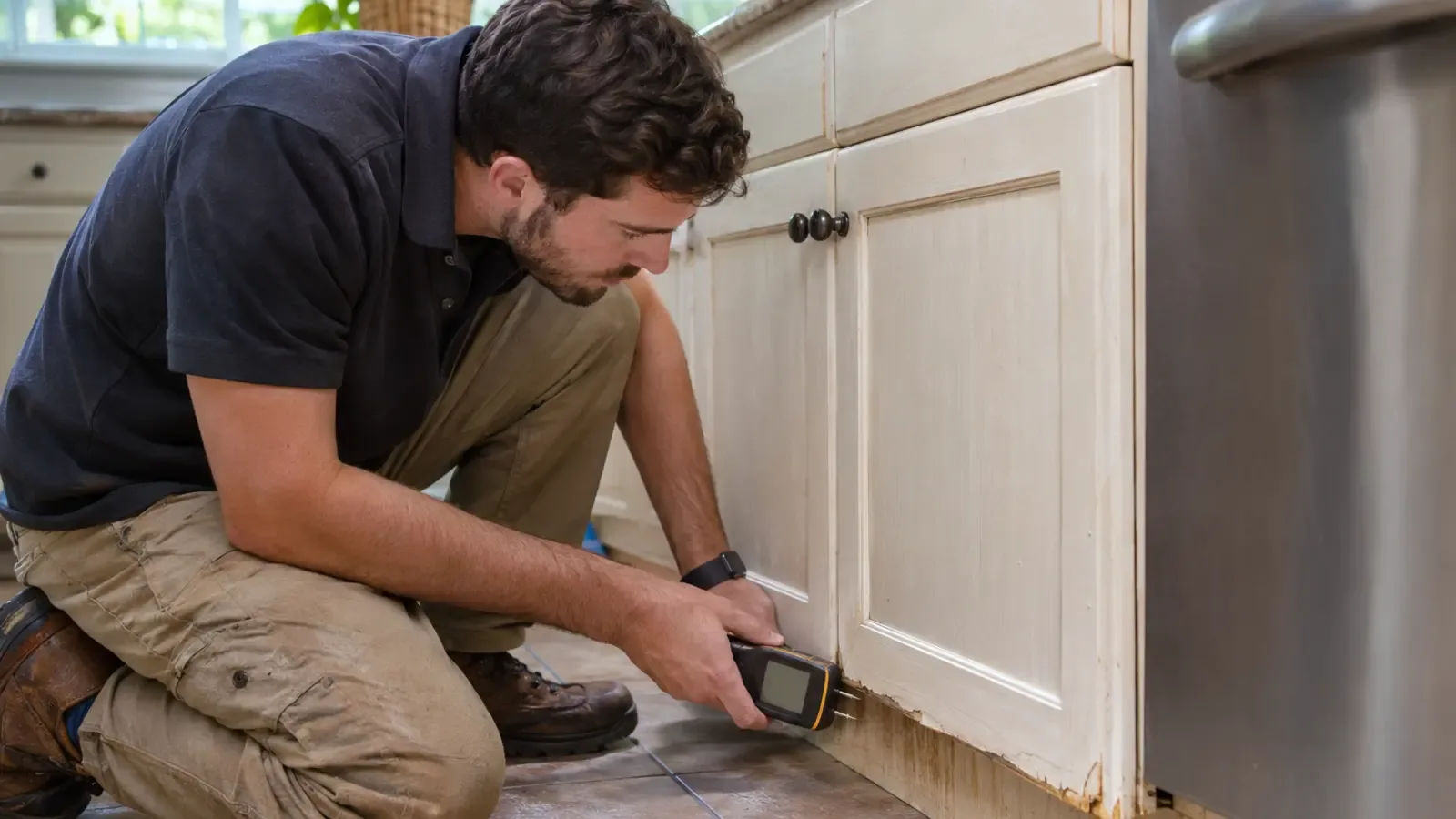
A dishwasher leak under cabinets may first show itself as a raised edge, peeling finish, or swollen toe kick beside the appliance. That change confirms that the cabinet material encountered moisture, but it does not reveal the entire wet area.
Water may have stopped at the toe kick, traveled beneath the cabinet base, or crossed under the finished floor and reached the subfloor. The practical question is not simply whether the trim looks damaged. It is which layers became wet and whether they can be accessed, dried, and evaluated without unnecessary removal.
Why the Toe Kick May Change Before the Floor Looks Wet
The toe kick is the recessed area along the bottom of a base cabinet. Its finished panel may be made from particleboard, medium-density fiberboard, plywood, or another wood-based product. Edges and unfinished surfaces can absorb water and expand.
That makes swelling one of the useful signs of hidden water damage. However, a swollen toe kick is a witness to moisture exposure, not a map of where all the water went. The visible floor may still feel dry while moisture remains behind the panel, beneath the dishwasher, or between flooring layers.
Swelling can also remain after the material dries. An older damaged toe kick therefore does not prove that the leak is still active. The leak source, moisture readings, and surrounding material conditions have to be considered together.
Read the Damage as a Four-Layer Moisture Path
A dishwasher leak can affect several connected materials. Following that path is more reliable than judging the loss from the most visible stain.
Layer 1: The toe kick records early exposure
A toe kick that has thickened, curled, softened, or separated at an edge has probably absorbed water. Peeling laminate or a darkened bottom edge may provide another clue.
This establishes that water escaped the appliance area or traveled beneath the cabinets. It does not establish how deep the moisture went.
Layer 2: The cabinet base can hide lateral movement
Water can spread along the floor under a cabinet run, especially where the cabinet base restricts airflow. An adjacent sink cabinet may become damp even when the dishwasher is the source.
Check accessible cabinet interiors for staining, softened corners, loose finishes, or a musty odor. Do not pry apart fixed cabinetry or cut openings merely to investigate.
Layer 3: The finished floor may conceal the wettest area
Water can enter at flooring edges, seams, plumbing openings, or the gap beneath the appliance. Vinyl, laminate, wood, and tile assemblies respond differently, but a dry surface does not confirm that the material beneath it is dry.
The EPA’s water-damage guidance specifically notes that underflooring beneath certain finished floors should be checked and dried when necessary. Our guide to water damage in different flooring systems provides additional material-specific context.
Layer 4: The subfloor determines the larger repair question
A wood subfloor may absorb moisture, swell, roughen, or delaminate. That does not mean every damp or swollen panel has lost structural capacity. APA notes that visible swelling or surface changes in plywood and oriented strand board do not, by themselves, prove structural failure after drying.
The decision depends on factors such as moisture duration, delamination, loss of fastening strength, softness, persistent distortion, and whether the panel can be dried and inspected adequately.
The Leak’s Timing Can Narrow the Appliance Problem
Where and when water appears can give an appliance technician a useful starting point. It cannot define the building’s moisture footprint.
| When water appears | Possible appliance-side source | What it means for the building |
| Near the front during washing | Door gasket, excess suds, alignment, or redirected spray | Water may still run underneath the appliance or into flooring seams |
| While the machine fills | Supply connection, inlet component, or overfill condition | Repeated releases may wet the same concealed area each cycle |
| While the machine drains | Drain hose, connection, or pump-related problem | Discharge water may contain food residue and detergent |
| Even when the dishwasher is idle | Pressurized supply connection or another nearby plumbing source | The wetting may continue between dishwasher cycles |
These are clues, not a remote diagnosis. Manufacturer guidance from Whirlpool identifies several potential sources, including door seals, supply and drain connections, inlet components, and pump or motor seals. The exact model instructions and an appliance professional should guide the repair.
What to Do When You Notice Swelling
The first response should stop additional water without exposing anyone to electricity or hidden damage. Then preserve the evidence needed to determine how far the moisture traveled.
Stop the appliance and water safely
Stop using the dishwasher. If water is near wiring, an outlet, a junction box, or the underside of the appliance, do not reach into the wet area or pull the machine forward.
Shut off the dishwasher’s water valve only if it is readily accessible from a dry location. Power should be disconnected at a correctly identified breaker only when the panel can be reached safely without crossing water. Arrange appliance or plumbing repair for the source.
Document the pattern before materials are moved
Photograph the swollen toe kick, flooring edges, nearby cabinet bases, visible water, and the ceiling below if the kitchen is upstairs. Note whether water appeared during filling, washing, draining, or while the appliance was off.
Documentation helps distinguish new damage from older swelling and gives the appliance technician and restoration provider a clearer starting point.
Treat appliance repair and structural drying as separate tasks
Replacing a hose, seal, or dishwasher may stop new water. It does not confirm that the cabinet base, flooring, or subfloor is dry.
Avoid installing a new appliance, replacing the toe kick, sealing flooring edges, or covering stained materials until the affected assembly has been evaluated. Closing the area too soon can trap moisture and make later access more disruptive.
How Hidden Subfloor Moisture Is Confirmed
A useful moisture assessment follows the suspected water path instead of testing only the swollen panel. It may include readings from the toe kick, cabinet sides, finished floor, wall edge, and accessible subfloor, with comparison readings from similar unaffected materials.
The EPA explains that moisture meters can help locate wet building materials and monitor drying. Readings still require interpretation because materials respond differently and surface measurements may not represent deeper layers.
Depending on the kitchen layout, controlled access may be needed beneath the dishwasher, behind a removable finish panel, from a crawlspace, or through a ceiling below. Random demolition is not the goal. The goal is enough access to identify the moisture boundary and confirm whether the deepest affected layer is drying.
Drying or Replacement Depends on the Material’s Condition
Swelling is not a universal replacement rule. The affected layer and its condition after drying matter more than the appearance of one trim panel.
- A swollen composite toe kick may remain distorted even after it is dry and may need replacement for serviceability or appearance.
- A cabinet box with softened joints, failing fasteners, or delamination may require repair or partial replacement.
- A plywood or OSB subfloor may remain usable if it can be dried and retains adequate integrity.
- A subfloor that is soft, badly delaminated, persistently wet, or unable to support flooring securely needs a different repair decision.
- Finished flooring may need selective access or removal when it blocks drying of the layers below.
The current ANSI/IICRC S500 public scope treats inspection, drying technology, instruments, structural restoration, and material assemblies as connected parts of water-damage restoration. That systems approach is especially useful when the visible cabinet damage is only the first clue.
Let the Deepest Wet Layer Set the Cleanup Scope
A swollen toe kick should prompt investigation, but it should not trigger an unsupported conclusion that the entire subfloor has failed. Trace the source, follow the likely water path, compare moisture conditions, and inspect the deepest affected layer that can reasonably be reached.
For appliance leak cleanup in Tallahassee when water has moved beneath cabinets or flooring, Extreme Carpet Care & Restoration provides residential water damage restoration. The appliance fault may still require a separate appliance technician or plumber. The important finish line is not a repaired dishwasher or a replaced toe kick. It is a repaired source and a floor assembly shown to be dry enough for the next repair step.
Frequently Asked Questions
Does a swollen toe kick prove that the subfloor is wet?
No. It proves that the toe-kick material encountered enough moisture to change. Water may have stopped there, or it may have moved beneath the cabinet and flooring. Moisture readings and appropriate access are needed to establish the subfloor’s condition.
Can I run another dishwasher cycle to find the leak?
Do not run the appliance again when water has appeared underneath it, reached electrical components, or damaged surrounding materials. An appliance technician can choose a controlled diagnostic method after addressing the electrical and water risks.
Does swelling mean the cabinet has mold?
Not necessarily. Swelling is a material response to moisture, not a mold diagnosis. A musty odor, visible growth, recurring dampness, or a leak that remained unresolved may justify further investigation. EPA guidance recommends drying wet materials promptly, generally within 24 to 48 hours when possible, but that window is guidance rather than a precise mold timer.
Will a swollen toe kick flatten after it dries?
Some dimensional change may lessen, but composite cabinet materials often remain distorted after significant wetting. Drying should still be completed before replacement so the new panel does not conceal moisture in the cabinet base or floor.
Can tile keep a dishwasher leak away from the subfloor?
Tile itself may tolerate surface water, but water can enter through perimeter gaps, transitions, damaged grout, or openings around the appliance and cabinets. The tile surface may look normal while moisture remains in the setting material, underlayment, or wood subfloor.
Who should handle a dishwasher leak first?
The active source needs to be stopped safely. An appliance technician may be appropriate for an internal component, while a plumber may be needed for a supply valve or connection. When water has entered cabinets, flooring, or the subfloor, a water-damage professional can evaluate the affected building materials.
Should the dishwasher be replaced before the floor is dried?
Usually, the source should be repaired or isolated first, but permanent appliance installation should wait until the space can be inspected and dried. Installing a new unit over a damp or damaged floor can hide the problem and limit access.