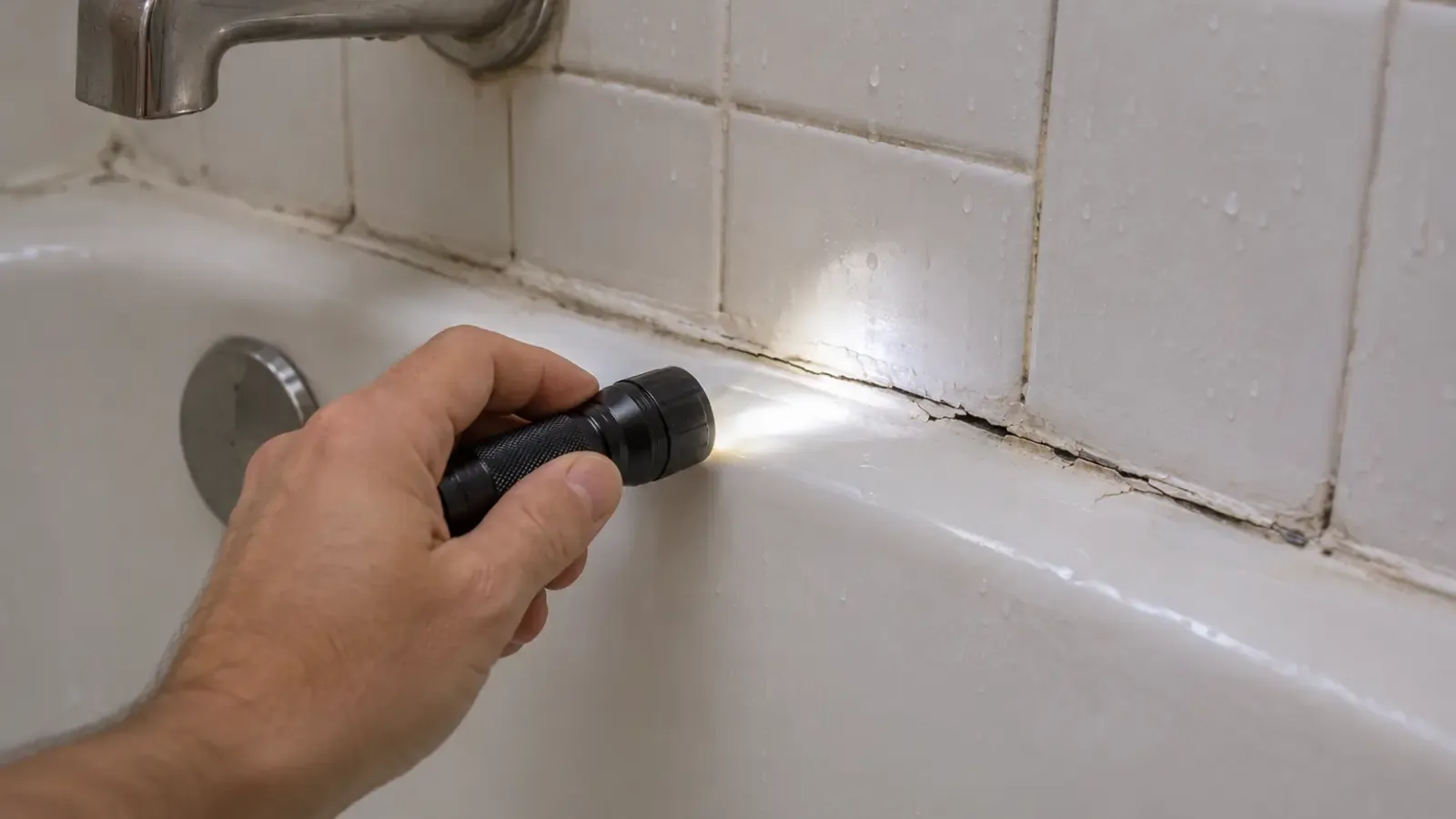
If your bathroom grout smells musty even after cleaning, the odor may not be coming from dirt on the open grout lines. Moisture can linger where tile meets a tub, shower base, wall, threshold, toilet, vanity, or baseboard. Those edge conditions often dry differently from the middle of the tiled surface.
A musty odor does not prove that mold is hidden behind the tile. It does tell you that the bathroom deserves a moisture check. Track three details: where the odor peaks, whether it returns after water use, and how nearby finishes change as the room dries.
Why the Edges Can Tell You More Than the Grout Field
The center of a tiled floor or wall is easy to see and wipe. The perimeter contains transitions, flexible joints, fixture penetrations, trim, and narrow gaps where water can collect or where drying air may not reach as well.
The Tile Council of North America explains that caulk is generally used where backing surfaces or planes change, such as a wall-to-floor joint. These surfaces can move independently. If rigid grout was used there, or if an existing flexible sealant has split, lifted, or pulled away, the joint can become a recurring wet spot. Even so, a failed edge joint is a clue, not proof that it is the only water source.
Pay particular attention to:
- Inside shower corners and the line where the wall meets the shower floor
- The joint between tile and a tub, shower base, or curb
- Door tracks, thresholds, niches, and plumbing penetrations
- The bathroom-floor perimeter beside baseboards or a vanity
- The toilet base and the flooring immediately around it
Use Odor Timing to Narrow the Search
Cleaning can temporarily change how a bathroom smells, so the first hour after scrubbing is not the best test. Let the surfaces dry, remove damp textiles, and notice what happens during the next normal use of the room.
Odor Returns After the Shower Runs
If the smell grows stronger after water reaches one corner, curb, or tub edge, inspect that local joint for a gap, crack, softness, or sealant that has separated. Also look on the other side of the wall and below the bathroom when those areas are accessible. Staining, peeling paint, swollen trim, or soft drywall moves the issue beyond routine grout cleaning.
Odor Stays Broad Across the Room
When the whole bathroom remains steamy, the problem may be slow drying rather than one failed joint. Damp towels, bath mats, shower curtains, and a fan that does not exhaust effectively can all keep moisture in the room. The EPA recommends using a bathroom fan that vents outdoors, or opening a window when conditions allow, during and after showering.
Odor Is Strongest at a Drain or Toilet
Do not assume every bathroom odor comes from grout. A drain with buildup, a dry trap in a seldom-used fixture, a loose toilet, or another plumbing problem needs a different response. A sewer-like or rotten-egg odor should be routed to plumbing evaluation rather than covered with fragrance or treated as a tile stain.
Run a Dry-Down Check Before Cleaning Again
Repeated scrubbing can add more water and cleaner without answering why the smell returned. A simple location-and-timing check gives you better information and avoids aggressive treatments that could damage grout, stone, or sealant.
- Remove wet mats, towels, and the shower curtain from the test area.
- Rinse away any remaining cleaner as the product and surface instructions allow, then dry the accessible tile and joints.
- Vent the bathroom to the outdoors and leave the area uncovered.
- Note whether the open grout field lightens while one edge stays dark or damp.
- After the next shower, check which joint becomes wet first and where the odor returns first.
- Stop the test if you find active leakage, a loose toilet, soft wall material, lifted flooring, loose tile, or visible growth extending beyond a small cleanable surface area.
This observation does not locate concealed water by itself. It does help separate a room-wide drying problem from a repeatable edge pattern that may justify a sealant, plumbing, tile-assembly, or moisture assessment.
Match the Next Step to the Condition
The right service depends on whether the material is dirty, stained, damaged, or being rewetted. One appointment should not be expected to solve all four conditions.
Cleaning Fits Surface Soil and Removable Staining
Professional cleaning can often remove embedded soil and improve some grout stains. The IICRC notes that soil which has not penetrated too deeply can usually be removed or visually improved, while deeper stains may require regrouting or a topical color seal. A test area is important because grout, natural stone, ceramic tile, and existing sealers do not all tolerate the same products.
For grout stain removal in Tallahassee, the practical question is not simply whether stronger chemistry is available. It is whether the discoloration is removable soil and whether the surface is dry and stable enough to clean. The Tile Council cautions that acids can attack cement-based grout, and poorly rinsed cleaners can leave residue that attracts more soil.
Joint Repair Fits Failed Perimeter Sealant
Cracked, missing, or detached sealant at a change of plane may need proper removal and replacement with a compatible flexible sealant. Applying new material over a damp, dirty, or failing joint can hide the condition without correcting it. If water is entering from a plumbing leak or a failed assembly, that source must be addressed before a cosmetic joint repair can hold.
Moisture Investigation Fits Recurring Odor and Material Changes
An odor that returns after the room appears dry, stays concentrated at the same edge, or accompanies dark joints, loose tile, swollen trim, soft drywall, or staining in an adjacent room deserves a broader moisture investigation. EPA guidance treats musty odor as a reason to look for present or past water and possible hidden mold, not as confirmation of a particular mold type.
If visible growth keeps returning, our guide to recurring shower-grout mold explains why moisture control matters. If the wall beside the tub or shower feels soft, review the clues associated with bathroom wall water damage before patching or resealing it.
Let the Edge Pattern Decide What Comes Next
A clean-looking grout field and a musty edge can belong to two different problems. Cleaning is appropriate for soil and some removable stains. A split perimeter joint calls for compatible repair. A recurring odor with damp or changing materials calls for source-finding before more cleaning.
When we assess a Tallahassee grout-cleaning project, the useful first question is what the cleaning is expected to change. If the tile assembly is dry and stable, professional cleaning may improve the grout. If moisture is still entering at or appearing near an edge, the leak, joint, or affected material needs the right trade and scope first.
Frequently Asked Questions
Can Professional Grout Cleaning Remove Stains?
It can remove embedded soil and improve many shallow stains, but no cleaning method can promise complete stain removal. Deep discoloration, damaged grout, color loss, mineral deposits linked to ongoing moisture, or staining beneath a worn coating may require a different treatment, color sealing, or regrouting after the underlying condition is understood.
Does Musty Grout Mean There Is Mold Behind the Tile?
No. Mustiness can point to damp materials and possible microbial growth, but odor alone cannot identify the source or prove what is behind the tile. Check ventilation, wet textiles, drains, plumbing, edge joints, and adjacent finishes. Recurrence in one location plus material changes is more concerning than odor by itself.
Should I Seal Grout That Still Smells Musty?
Not until the surface is clean, dry, stable, and the odor source has been addressed. Sealer is not a repair for a leak, a failed movement joint, or wet material below the finish. Product suitability also depends on the grout, tile or stone, existing coating, and source of moisture.
Why Does the Smell Return Only After Someone Showers?
The shower adds liquid water and humidity. If one edge is rewetted, the odor may intensify there. If the entire room dries slowly, towels, mats, curtains, drains, and other surfaces can contribute. Compare where the smell starts rather than assuming the grout is responsible.
Can I Remove Old Shower Caulk and Replace It Myself?
Small, accessible maintenance joints may be manageable for an experienced homeowner who follows the sealant and surface manufacturers’ instructions. Stop if the joint is wet, the backing is soft, tile is loose, the gap is unusually deep, or the odor seems to come from inside the assembly. Those conditions need assessment before resealing.
Will Bleach Solve a Musty Grout Odor?
Bleach may change the appearance of some surface growth, but it does not repair failed sealant, improve ventilation, clear a plumbing defect, or dry concealed material. It can also be unsuitable for some tile, stone, grout, sealers, and nearby finishes. Follow the surface and cleaner manufacturers’ directions and never mix cleaning products.
Who Should Inspect a Bathroom When Grout Cleaning Is Not Enough?
Match the professional to the evidence. A plumber handles active fixture, supply, drain, toilet, or trap problems. A qualified tile professional evaluates failed joints or tile-assembly concerns. A water-damage or mold professional may be appropriate when dampness or growth extends into adjacent materials. Cleaning remains the right lane when the assembly is dry, and the issue is removable surface soil.