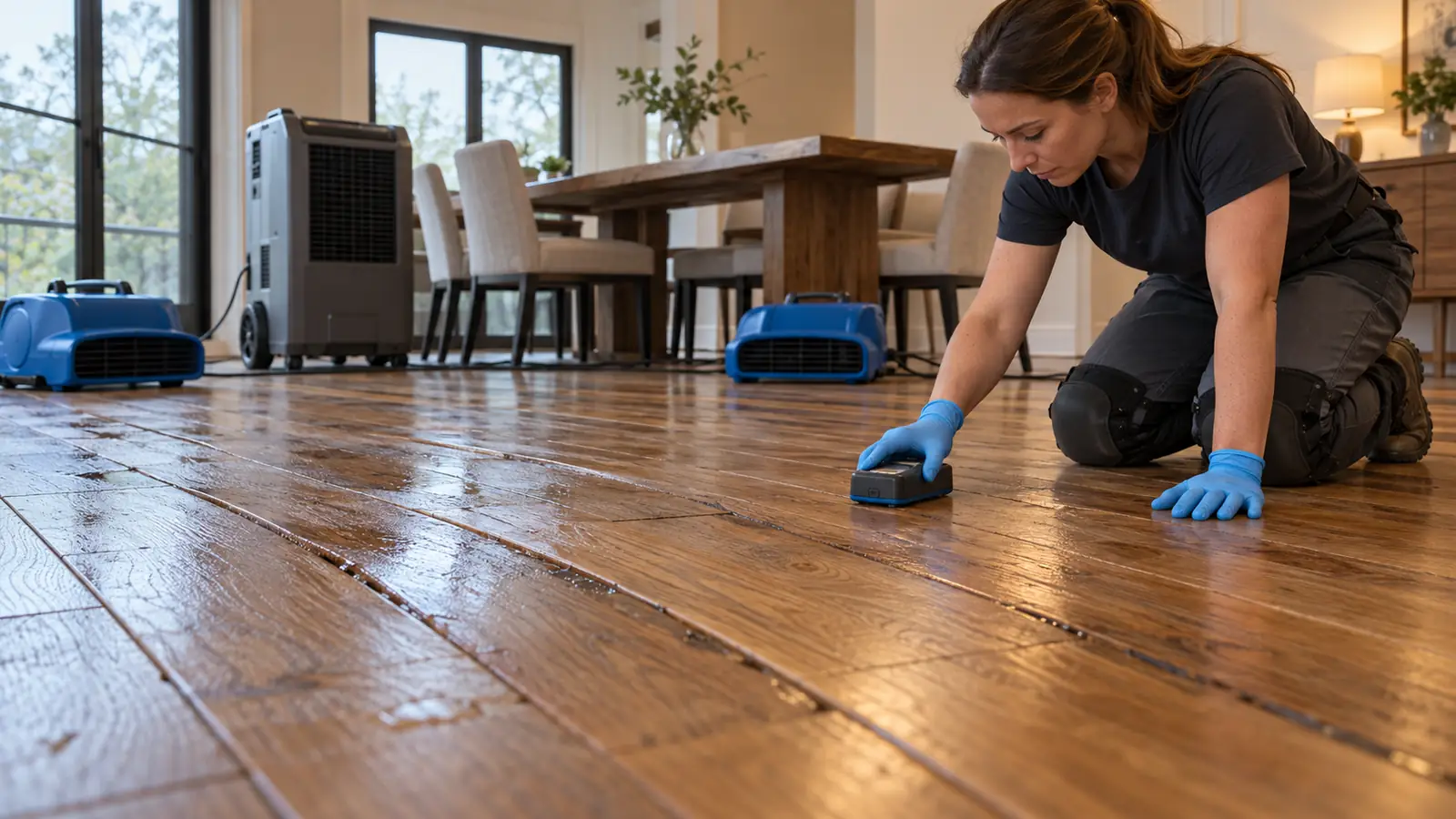
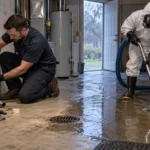
A puddle disappears faster than the moisture beneath a hardwood floor. After summer thunderstorms or storm-driven rain reaches North Florida interiors, the surface may look dry while board edges begin to rise. An appliance leak can leave the same uneven pattern without any storm outside.
Understanding how to fix hardwood floors that got wet starts with recognizing what changed. Cupping, crowning, and buckling describe different shapes, not interchangeable repair instructions. The right response depends on the water source, hidden moisture, flooring construction, and whether the boards remain sound.
What to Do Before You Touch the Floor
Your first priority is stopping further damage without entering an unsafe area. Cosmetic repairs can wait; an active leak cannot.
Stop the Water and Check for Hazards
Shut off a leaking appliance’s water supply only if you can reach it safely. Stay out of standing water near electrical equipment, outlets, or damaged wiring. Electrical hazards require qualified assistance before cleanup begins.
Floodwater and sewage backups need a different response from a small clean-water spill. Avoid contact with potentially contaminated water. Do not assume that clear-looking water is clean.
If you rent or manage the property, report the leak promptly and document its location.
Remove Small Clean-Water Spills Safely
For a limited spill with no electrical or contamination concerns:
- Blot up water with absorbent towels.
- Remove wet rugs and movable belongings.
- Photograph affected boards and nearby trim.
- Keep foot traffic away from lifting or unstable flooring.
Water can travel into adjoining floor coverings. Differences in how water affects wood, tile, and carpet help explain why the visible puddle may underestimate the affected area.
What Cupping, Crowning, and Buckling Mean
The board’s shape offers a useful clue. It does not establish the moisture source or prove whether replacement is necessary.
Cupping: The Edges Rise
Cupping creates a shallow dish across a board. Its edges sit higher than its center.
In solid hardwood, this commonly develops when the underside contains more moisture than the face. Water beneath the boards, a damp subfloor, or moisture from below can create that imbalance.
Some cupping improves after the moisture source is corrected and the floor stabilizes. Permanent deformation may remain, so repairing water-damaged hardwood floors requires reassessment after drying.
Crowning: The Center Rises
Crowning creates the opposite profile: the middle stands above the edges. Excess moisture near the upper surface can contribute.
Crowning can also follow premature sanding. If raised edges are sanded flat while a cupped board remains wet, the board may dry into a profile with low edges and a high center. Sanding cannot substitute for moisture correction.
Buckling: Boards Lift Away
Buckling involves flooring lifting away from its supporting surface. Boards may form pronounced humps or separate from their attachment.
This is more serious than slight surface unevenness. Avoid walking across raised sections or trying to hammer them flat. Evaluation should consider moisture, attachment failure, expansion space, and damage beneath the flooring.
How to Dry Wet Hardwood Without Rushing Repairs
Drying must address moisture inside the floor assembly. A dry-looking finish does not confirm that the boards and subfloor are ready for repair.
Control Moisture Beneath the Surface
After safe water removal, appropriate airflow and dehumidification may support drying. Opening windows during humid weather can introduce additional moisture, so outdoor conditions matter.
Do not direct fans across visible mold. Flood-affected heating and cooling systems also need evaluation before use.
Preventing secondary water damage includes managing lingering moisture instead of covering damp areas with rugs or moving furniture back too soon.
If water has spread beneath your hardwood, call 850-422-2227 to discuss residential water damage restoration. Describe the water source, affected rooms, and any lifting boards or suspected contamination so the next steps can address cleanup and drying before cosmetic repair.
Confirm Readiness With Moisture Assessment
A qualified flooring or restoration professional can assess moisture in affected materials and compare conditions with appropriate dry reference areas. Readings require interpretation for the material and measuring method.
One surface reading cannot describe every layer beneath the floor. The drying decision should account for the subfloor, remaining moisture sources, and changing conditions.
Avoid choosing a sanding date simply because the surface feels dry or a certain number of days has passed.
Choose Between Cleaning, Refinishing, and Replacement
Fixing water-damaged hardwood floors involves separate decisions about cleanliness, appearance, and physical condition. Each option addresses a different problem.
Cleaning for Sound, Stable Flooring
Once the floor is appropriately dry and any contamination concerns are resolved, hardwood floor cleaning can address surface dirt and buildup.
Cleaning cannot reconnect detached boards, reverse delamination, or flatten permanent warping. A shinier surface does not establish that hidden moisture has disappeared.
Refinishing for Suitable Boards
Sanding and refinishing may suit stable hardwood with repairable surface damage or persistent unevenness. First, assess the remaining wood thickness, previous sanding, and overall condition.
Engineered hardwood requires particular care because its real-wood wear layer varies in thickness. Some products cannot tolerate the sanding needed to remove significant distortion.
A small repair may also look different from the surrounding finish. Color and sheen matching deserve consideration before work begins.
Replacement for Permanent Damage
Replacement becomes more likely when boards split, detach, remain severely distorted, or develop separation between engineered layers. Contamination and inaccessible wet materials can also change the salvage decision.
Before new flooring goes down, the supporting surface must be suitable, and the moisture problem must be corrected. Replacing only the visible damage while leaving wet materials underneath can create another failure.
Localized replacement may be possible, but matching dimensions, construction, and finish can limit the available options.
Mistakes That Can Make Water Damage Worse
Knowing how to fix a wood floor damaged by water includes recognizing actions that can complicate recovery.
Avoid these shortcuts:
- Sanding raised edges before the floor stabilizes.
- Using steam mops or repeated wet mopping.
- Aiming concentrated heat at distorted boards.
- Covering damp flooring with rugs or plastic.
- Assuming discoloration alone identifies mold.
- Installing replacement boards over an unresolved moisture problem.
Do not pry up flooring simply to investigate. Removal can damage reusable boards and expose concealed hazards. The need for access should guide the removal plan.
Reduce the Chance of Another Wet-Floor Problem
Prevention starts with the source that caused the damage. Floor care alone cannot compensate for a recurring plumbing or building leak.
Practical steps for minimizing water damage to wood floors include wiping spills promptly and checking areas near sinks, appliances, and exterior doors. Remove and dry wet entry mats instead of leaving them against the wood.
Maintain indoor conditions within the flooring manufacturer’s recommendations. Watch for renewed edge lifting, damp trim, or recurring stains after heavy rain.
The goal is a stable floor over a dry, suitable supporting surface. Its final appearance should be addressed only after those conditions are established.
Frequently Asked Questions
Can cupped hardwood floors flatten after drying?
Some cupped boards improve once the moisture source is corrected and the wood stabilizes.
Permanent deformation can remain, especially after substantial moisture exposure. Moisture assessment and the board’s condition help determine whether refinishing or replacement is appropriate.
How do you fix a warped wood floor from water?
First, stop the water source and assess electrical hazards, contamination, and the extent of wet materials. Next, address moisture in both the flooring and the supporting layers. Only after stabilization should you decide whether the remaining distortion needs sanding, individual board replacement, or broader repairs.
How long should you wait before sanding wet hardwood?
There is no reliable waiting period that fits every floor. Wood thickness, subfloor conditions, indoor humidity, and water exposure all affect drying. Use interpreted moisture readings and stable conditions to guide the decision rather than the calendar.
Can you fix a wood floor that got wet without removing it?
Sometimes, if the boards remain sound and the underlying materials can dry adequately in place. Trapped moisture, contamination, detachment, or inaccessible damage may require selective removal. The ability to dry and clean the entire affected assembly matters more than preserving the visible surface alone.
Does buckling mean the entire floor needs replacement?
Buckling does not automatically establish the extent of replacement. An assessment must identify attachment damage, affected boards, subfloor condition, and the moisture source.
Localized repairs may be possible, but widespread deformation or material damage can require a larger replacement area.
Can humid summer weather cause cupping without a visible leak?
Yes, wood responds to moisture in the surrounding environment as well as direct water exposure. Humidity differences above and below solid hardwood can contribute to uneven moisture content. A hidden leak, damp crawlspace, or other moisture pathway still needs consideration before blaming weather alone.
Should you open windows to dry hardwood after heavy rain?
Only when outdoor conditions support drying and opening the building is otherwise appropriate.
Humid outdoor air can slow moisture removal from an already damp interior. Controlled drying may be more useful, and visible mold or flood-affected electrical systems require additional precautions.
Can hardwood exposed to storm surge or sewage be saved?
Potential contamination changes the decision and makes ordinary spill-cleanup advice inappropriate. Assessment must consider what contacted the wood and whether affected layers can be adequately cleaned and dried. Do not assume that a dry surface means the floor is suitable to retain.
Are dark seams proof of mold beneath the floor?
No. Discoloration alone cannot establish what caused a stain or what is beneath the boards. Water-related staining, metal reactions, and other material changes can affect appearance.
Persistent dampness, odor, or visible growth warrants investigation rather than cosmetic covering or a diagnosis from color alone.
Can engineered hardwood be repaired like solid hardwood?
Engineered flooring requires a different assessment because it contains bonded layers and a limited wear surface. Permanent layer separation does not reverse simply because moisture dries out. Before sanding or replacing boards, check the product’s construction, manufacturer’s instructions, and the condition of its layers.