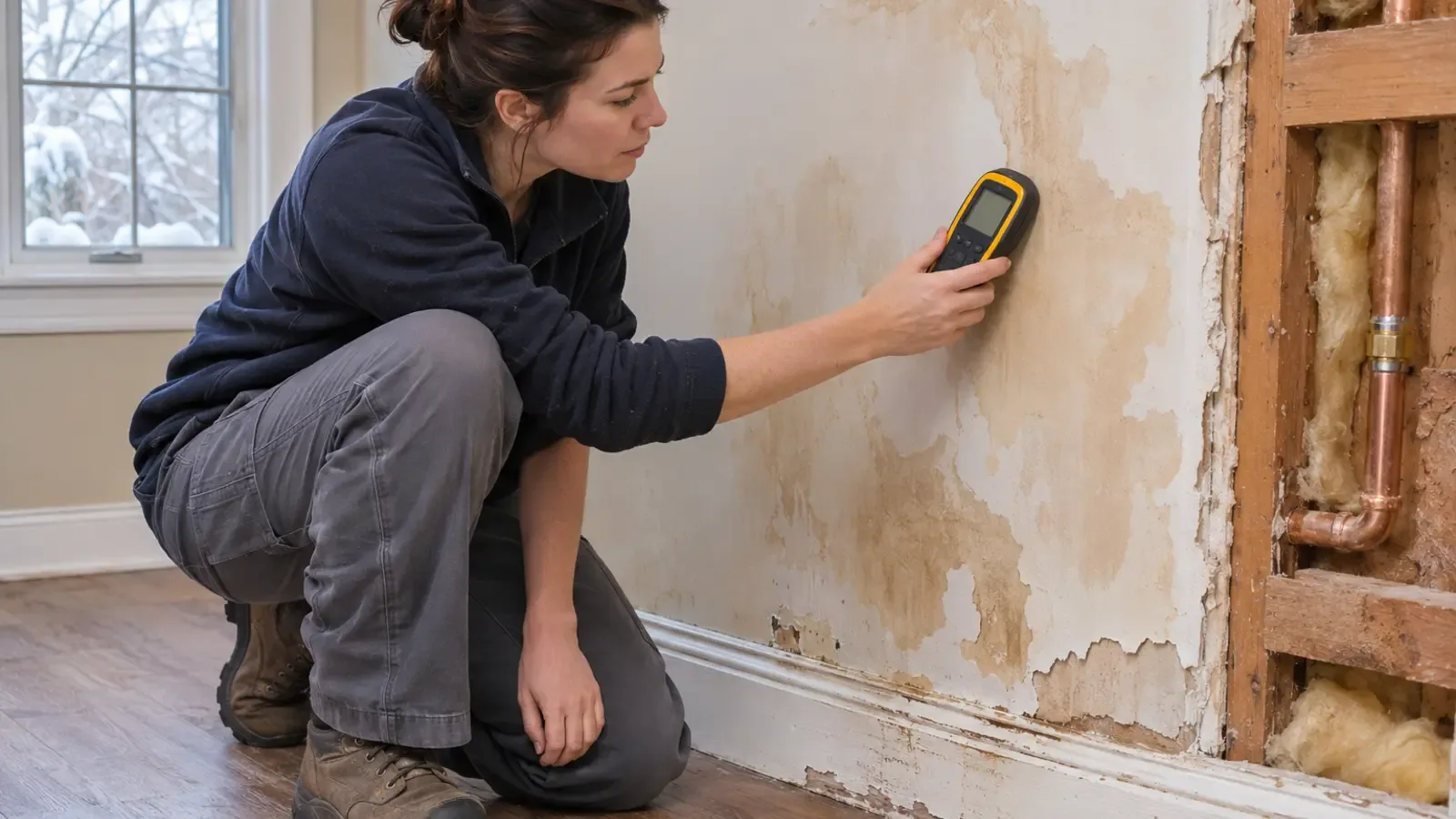
A burst pipe can stop leaking once the water is shut off, but that does not mean the damage has stopped changing. Water released inside a wall, attic, cabinet, or crawl space may have already traveled into materials that look dry from the room.
Cold-related pipe failures are less common in Tallahassee than storm or appliance losses, but local freezes do happen. The most useful response is to treat the visible break as the starting point of your inspection, not the boundary of the damage.
Make the Area Safe Before Checking the Damage
Once the water source is controlled, pause before entering the wet area or starting cleanup. Electrical equipment, unstable ceilings, and slippery flooring can turn an ordinary inspection into a safety problem.
- Stay out of standing water if outlets, cords, appliances, light fixtures, or the electrical panel may be affected.
- Do not operate a breaker, appliance, wet vacuum, or other electrical equipment while standing in water. The CDC recommends qualified electrical inspection before wet electrical equipment is returned to service.
- Keep people and pets away from a sagging, bulging, or dripping ceiling.
- Photograph the failed pipe, standing water, stains, flooring, furniture, and rooms below before moving or discarding items.
- Record when the leak was discovered and, if known, how long water may have been flowing.
For a broader emergency sequence, review what to do during the first 60 minutes after water damage.
Know the Tallahassee Utility Responsibility Line
The location of the break helps determine whether you should begin with a private plumber or the water utility. It does not determine insurance coverage or who must handle interior drying.
For City of Tallahassee utility customers, the City states that homeowners are responsible for breaks between the meter and the home or within the home. City Utilities handles damage between the water main under the street and the meter, or within the main itself. Homeowners served by another utility should confirm that provider’s boundary instead of assuming the same rule applies.
The City’s January 16, 2026 cold-weather notice also explains that a frozen pipe may leave a home soaked when the pipe thaws. A line that stopped flowing overnight should therefore be watched carefully as temperatures rise, even if no active leak was visible during the coldest hours.
Who to Call for Water Damage After a Burst Pipe
A burst-pipe loss often requires more than one professional because repairing the pipe and drying the home are different jobs.
| Call | What that professional addresses | When the call matters |
| Plumber | Locates and repairs the failed pipe, valve, or fitting | The source is still active, frozen, cracked, or not fully diagnosed |
| Electrician | Evaluates wet wiring, fixtures, outlets, panels, and appliances | Water reached electrical components or safe power use is uncertain |
| Water-damage restoration provider | Extracts water, evaluates moisture spread, dries materials, and documents affected areas | Water reached drywall, insulation, carpet padding, flooring assemblies, cabinets, or multiple rooms |
| Insurance company or agent | Explains notice requirements, documentation, deductibles, and policy-specific coverage | The damage may lead to a claim or significant repair expense |
| Water utility | Evaluates a possible utility-side break or service issue | The suspected problem is at the meter, street connection, or public main |
These calls may happen in parallel. A plumber should not be expected to confirm that a subfloor or wall cavity is dry, while a restoration provider does not automatically replace the need for source repair.
Trace the Water in Four Directions
The visible puddle tells you where some water ended up. A better inspection follows the route water could have taken before the supply was shut off.
Start at the Failed Pipe
Check the wall, cabinet, ceiling, or utility area immediately around the break. Look for softened drywall, wet insulation, swollen trim, peeling paint, or water emerging from penetrations around pipes.
Do not open a wall or ceiling when electrical hazards, mold, asbestos-containing materials, or structural instability may be involved. An inspection can establish whether controlled access is needed without beginning unnecessary demolition.
Look Sideways Into Connected Spaces
Water can move behind baseboards, beneath continuous flooring, through cabinet bases, and along seams. Inspect the opposite side of the wall, adjoining closets, neighboring rooms, and the edges of built-in cabinets.
A stain that ends at a doorway does not prove the moisture stopped there. Watch for darkened grout, damp carpet edges, lifting floor seams, swollen baseboards, and changes around thresholds.
Check the Level Below
If the break occurred upstairs, in an attic, or above a crawl space, inspect directly below it and then expand outward. Water may follow framing, pipes, wiring penetrations, or light fixtures before appearing on a ceiling.
Keep clear of any ceiling that is sagging or holding water. Do not puncture it as a routine do-it-yourself drainage step.
Find Concealed Reservoirs
Carpet padding, insulation, cabinet toe kicks, wall cavities, and subflooring can remain wet after exposed surfaces have been wiped dry. A musty odor, persistent room humidity, soft wall edges, or flooring that changes over the next several days can indicate retained moisture.
Check Materials as Assemblies, Not Surfaces
A floor, wall, or cabinet is made of layers. Burst pipe cleanup in Tallahassee should account for those layers before repair work covers them again.
- Carpet: The face fibers may feel dry while the padding or subfloor remains wet.
- Wood and laminate flooring: Raised edges, tight seams, cupping, discoloration, or softness may indicate moisture below the finish.
- Tile: Tile itself may look unchanged while water reaches grout, adhesive, perimeter gaps, or a wood subfloor.
- Drywall: Staining alone does not decide whether drywall can remain. Swelling, sagging, crumbling, wet insulation, contamination, and the ability to dry the cavity all matter.
- Cabinets: Check unfinished edges, toe kicks, end panels, and the floor beneath the cabinet run.
- Contents: Move dry belongings away from the affected area, but photograph damaged items before disposal when an insurance claim is possible.
Our guide to water damage in tile, wood, and carpet flooring explains why a dry surface does not always mean the full flooring assembly is dry.
The EPA recommends drying water-damaged areas and items within 24 to 48 hours where possible. That period is a practical moisture-control guideline, not a guarantee that mold will begin at a precise hour or that every material must automatically be discarded.
The agency also notes that moisture meters can help evaluate and monitor materials such as wallboard, carpet, wood, brick, and concrete.
Confirm Drying Before Closing or Repainting
Cleanup is not complete merely because the pipe has been repaired and the floor has been mopped. Before trim, drywall, paint, or flooring is replaced, confirm that the source is corrected and the affected assembly has reached an appropriate dry condition.
A sound completion check should answer these questions:
- Has the failed pipe been repaired and safely tested?
- Have all affected rooms, wall sections, floors, cabinets, and lower levels been identified?
- Are moisture conditions being compared with appropriate unaffected materials or drying goals?
- Have wet electrical components been evaluated before power or appliances are restored?
- Are stains, odors, swelling, or dampness continuing to change?
- Can repairs proceed without sealing moisture inside the assembly?
The published ANSI/IICRC S500 water-damage restoration standard treats inspection, drying technology, documentation, building materials, and specialized experts as separate parts of professional restoration. That helps explain why plumbing repair alone does not settle every cleanup decision.
Finish the Water Path, Not Just the Pipe Repair
The central question after a cold-night pipe failure is not only, “Where did the pipe break?” It is, “Where did the released water travel before the supply stopped?”
A small spill that remained on a clean, accessible hard surface may be manageable with prompt, safe cleanup. Water that entered walls, flooring, insulation, cabinets, ceilings, or electrical areas deserves a broader assessment.
For professional water damage cleanup in Tallahassee, Extreme Carpet Care & Restoration offers 24/7 residential water damage restoration for burst-pipe and other household water losses.
Frequently Asked Questions
Can a frozen pipe be damaged before I see water leaking?
Yes. Ice may temporarily restrict water movement, so a crack can become apparent only as temperatures rise and water begins flowing again. Keep the supply controlled and involve a plumber when a frozen line, pressure loss, bulging pipe, or possible break remains unresolved.
Should I call a plumber or a water-damage restoration company first?
Call a plumber when the pipe still needs to be isolated, diagnosed, or repaired. Contact a restoration provider when water has entered building materials or spread beyond a small surface spill. Significant losses often require both services at nearly the same time.
Can I clean up a small burst-pipe spill myself?
A limited amount of water on an accessible hard surface may be manageable if the water source is known, the area is electrically safe, and water has not entered nearby materials. Professional assessment becomes more appropriate when carpet padding, drywall, insulation, cabinets, flooring layers, ceilings, or multiple rooms are involved.
How can I tell whether water is trapped behind a wall?
Possible clues include soft or swollen drywall, peeling paint, damp baseboards, moisture on the opposite side of the wall, musty odors, or a stain that continues to change. Surface clues cannot always establish the full boundary, so moisture measurement or controlled access may be needed.
Does wet drywall always need to be replaced?
No. The decision depends on the drywall’s physical condition, contamination, exposure time, cavity conditions, and whether the material can be dried appropriately. Sagging, swollen, crumbling, mold-affected, or contaminated drywall is less likely to remain suitable.
Should I start fans immediately?
Only after electrical safety and water conditions are understood. Do not plug in equipment near standing water or wet electrical components. If mold growth is already suspected, uncontrolled airflow may also spread spores into unaffected areas.
Will homeowners insurance cover damage from a burst pipe?
Coverage depends on the policy and circumstances. Florida consumer guidance distinguishes sudden, accidental plumbing discharge from flooding and warns that exclusions may apply to continuous leakage or unrepaired maintenance problems. Notify the insurer promptly, preserve photographs and receipts, and follow the policy’s repair and documentation requirements.
Who handles a pipe break near the water meter in Tallahassee?
For City of Tallahassee utility customers, the City identifies the main-to-meter portion as its responsibility and the meter-to-home or inside-home portion as the customer’s responsibility. Contact the applicable water provider when the break location is uncertain or when another utility serves the property.