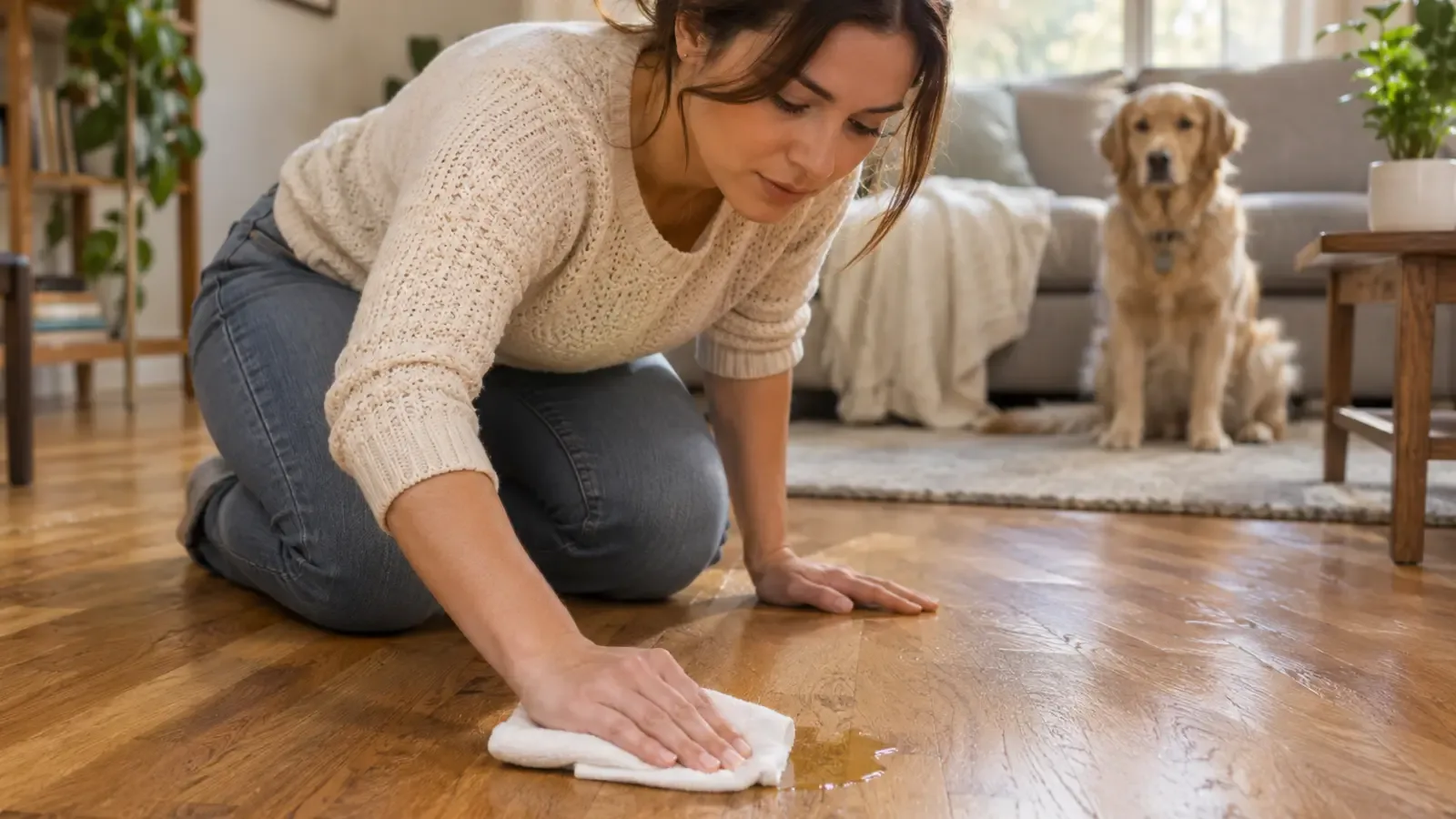
A fresh dog accident on hardwood creates two problems at once: urine on the finish and liquid trying to enter gaps, scratches, worn spots, and board edges. The safest response is not a stronger cleaning mixture. It is faster removal with tighter moisture control.
If you are searching for how to remove dog urine stains from hardwood floors, start by blotting the puddle dry, then use only a small amount of cleaner approved for that specific floor and finish. Apply it to a cloth when possible, not as a puddle on the boards. A dark mark, recurring odor, or raised seam after the surface dries is no longer a simple wipe-up problem.
First, Decide Whether You Have Residue or Material Damage
Pet stains on hardwood floors can sit in different layers. Fresh urine may still be entirely above an intact finish. Urine left on a worn, scratched, or unfinished area can reach the wood. Liquid at a joint can move below the visible surface before the center of the board looks damaged.
Do not use color alone to diagnose the depth. Instead, check whether the spot is still wet, whether the finish looks intact, whether the darkest area follows a seam, and whether a board edge feels raised or unstable. Odor that remains after the surface is dry also suggests that surface cleaning may not reach the source.
That distinction matters because successful odor removal and successful color correction are separate outcomes. Cleaning can remove residue from an intact finish. It cannot reliably reverse a permanent color change inside the finish or wood.
Use a Dry-First Cleanup Sequence for a Fresh Accident
The goal is to transfer liquid out of the area without wiping it toward a joint. Keep your dog, children, and foot traffic away while you work.
Lift the Puddle Before It Spreads
Lay a white, absorbent towel or several paper towels over the urine and press straight down. Replace saturated towels and repeat until the next towel comes away nearly dry. At the perimeter, work from the outside toward the center. Do not scrub across the grain or push the puddle along a seam.
If urine has pooled beside a baseboard, threshold, floor vent, or expansion gap, do not flush that edge with water. Blot what you can reach and note the location for reassessment after drying.
Put Approved Cleaner on the Cloth, Not Into the Joint
Identify the flooring and finish from product records, the installer, or the manufacturer’s care guide. A cleaner labeled for one type of wood-floor finish may not suit another. The National Wood Flooring Association recommends a small amount of a pH-balanced wood-floor cleaner for common spills and an inconspicuous test before treating a stubborn spot.
For an intact finish, lightly dampen a clean white cloth with the approved cleaner and blot or wipe the affected surface. Using the cloth gives you more control near seams than spraying the floor.
Turn the cloth often, then use a separate dry towel to remove any excess immediately. If the label requires a dwell time or rinse, follow it only if the floor manufacturer also permits that method without saturation.
If the floor is unfinished, visibly worn through, waxed, naturally oiled, or of unknown construction, stop after dry blotting and get product-specific advice. Do not experiment on exposed wood.
Dry the Spot and Reassess It
Press a fresh dry towel over the area, then allow normal room airflow to finish the job. Do not use a steam mop, hair dryer, heat gun, or concentrated heater. Check the spot again after it is fully dry and in normal light.
One controlled treatment is more informative than several wet attempts. If the odor or mark remains, repeated applications may add moisture without reaching material below the finish.
Skip Household Mixtures That Can Damage the Finish
Online advice often treats every wood floor as interchangeable. Flooring guidance does not. The NWFA’s 2025 technical publication advises against vinegar, traditional mop-and-bucket cleaning, and steam cleaning on wood floors. Manufacturer instructions from Bruce and Shaw also warn against excess water and harsh or unapproved cleaners.
Avoid these shortcuts unless the flooring and finish manufacturer expressly approves the exact product and method:
- Vinegar-and-water mixtures, which can degrade or dull some finishes.
- Straight household hydrogen peroxide, bleach, ammonia, or wood bleach, which can alter color or damage a coating.
- Baking-soda pastes or abrasive scrubbing, which can scratch or leave residue.
- An enzyme product labeled only for carpet, upholstery, or general hard surfaces.
- Wet mops, steam mops, saturation, or plastic-covered soaking treatments.
A formulated wood-floor product may contain an ingredient such as hydrogen peroxide and still be designed for a particular finish. That does not make a bottle of household peroxide equivalent. Follow the complete product label, not an ingredient shortcut.
Never mix cleaning products. The CDC warns that household cleaners can release dangerous gases when combined. Keep pets away until the treated area is dry according to the product label.
Know When More Cleaning Is the Wrong Next Step
Wood naturally exchanges moisture with its surroundings, and changes in moisture content affect its performance, as the USDA Forest Products Laboratory explains. Adding liquid to a seam is therefore not a neutral way to test whether a stain will improve.
| What you notice after drying | What it may mean | Better next step |
| No odor, no color change, flat seam | The accident likely remained above an intact finish | Resume normal care and watch the area |
| Mark remains but the surface is dry and odor-free | The finish or wood may be discolored rather than dirty | Ask a flooring professional about finish repair before using stronger chemicals |
| Odor returns after mopping or during humid conditions | Residue may be in a joint, board, underlayment, or subfloor | Stop repeated wet cleaning and have the depth assessed |
| Darkening follows board edges | Liquid may have entered through joints or finish breaks | Keep the area dry and arrange a flooring evaluation |
| Edge is raised, cupped, soft, loose, or delaminated | Moisture may have changed the flooring material | Treat it as a repair issue, not a stain-removal task |
NWFA repair guidance notes that pet-urine stains may require resanding or replacement, depending on the floor and depth of damage. Engineered wood also has a limited wear layer, so sanding is not automatically available. Our guide to engineered wood floor water damage explains why moisture removal and plank repair can become separate decisions.
Let the Layer Set the Goal
To clean pet stains from hardwood floors safely, match the response to the layer involved: blot and spot-clean residue above an intact finish; seek finish or flooring repair for discoloration inside the coating or wood; and investigate below the boards when odor, movement, or seam damage persists.
The practical stopping rule is simple. Once the surface is dry, more liquid should not be the default response to a mark that has not changed. Pet-stain removal on hardwood floors succeeds when it removes accessible residue without creating a second moisture problem.
For Tallahassee-area homes, we offer hardwood floor cleaning and pet stain and odor removal services. However, if the floorboards or subfloor appear damaged, we recommend consulting a qualified flooring professional to assess the need for repairs.
Frequently Asked Questions
Can I Use an Enzyme Cleaner on Sealed Hardwood?
Only when the product label names your flooring type and the floor or finish manufacturer permits it. “Safe for hard surfaces” is not the same as approved for a specific wood finish. Use the smallest permitted amount, keep it out of open seams, observe the listed dwell time, and remove excess promptly. Do not use a carpet-only enzyme cleaner on hardwood.
How Do I Get Pet Stains Out of Hardwood Floors After They Have Dried?
Begin with the manufacturer-approved spot-cleaning method for the floor, not a soaking treatment. If the dry mark remains after accessible residue is removed, the color may be in the finish or wood. Dark stains, finish loss, and seam-centered discoloration deserve a flooring assessment before peroxide, bleach, sanding, or another aggressive treatment.
Why Is the Stain Darkest Between the Boards?
Board joints are pathways where liquid can move below the finished surface. Dark edges do not prove how far urine traveled, but they make flooding the area especially risky. Blot the surface, avoid adding liquid to the joint, and watch for odor, swelling, or movement after drying.
Will Hydrogen Peroxide Remove a Black Urine Stain?
Some professional or manufacturer-approved repair systems use peroxide or other chemical treatments in controlled situations. Household peroxide can also lighten the surrounding wood or alter the finish, leaving a pale patch without resolving deeper odor. A black or deeply set mark should be evaluated as potential material damage rather than treated as an ordinary surface spot.
Why Does the Urine Smell Return After I Mop?
Mopping may introduce moisture to dried residue in a joint or below the floor, making the odor noticeable again. It can also spread residue across a larger area. This pattern does not prove mold or identify the affected layer, but it is a reason to stop repeated wet cleaning and assess the seam, board, and material below.
What Should I Do if I Rent the Home?
Photograph the area, record when you found it, blot it dry, and check the lease or contact the property manager before applying stain removers, peroxide, bleach, or attempting sanding. Product experiments can change the finish and make the original damage harder to distinguish from cleaning damage.
When Do Repeated Accidents Call for a Veterinarian?
If a previously house-trained dog suddenly starts urinating indoors, or you notice frequent attempts, straining, pain, blood, or very little urine, contact a veterinarian. Veterinary guidance notes that abnormal urination can have medical as well as behavioral causes; difficulty producing urine may require urgent care.