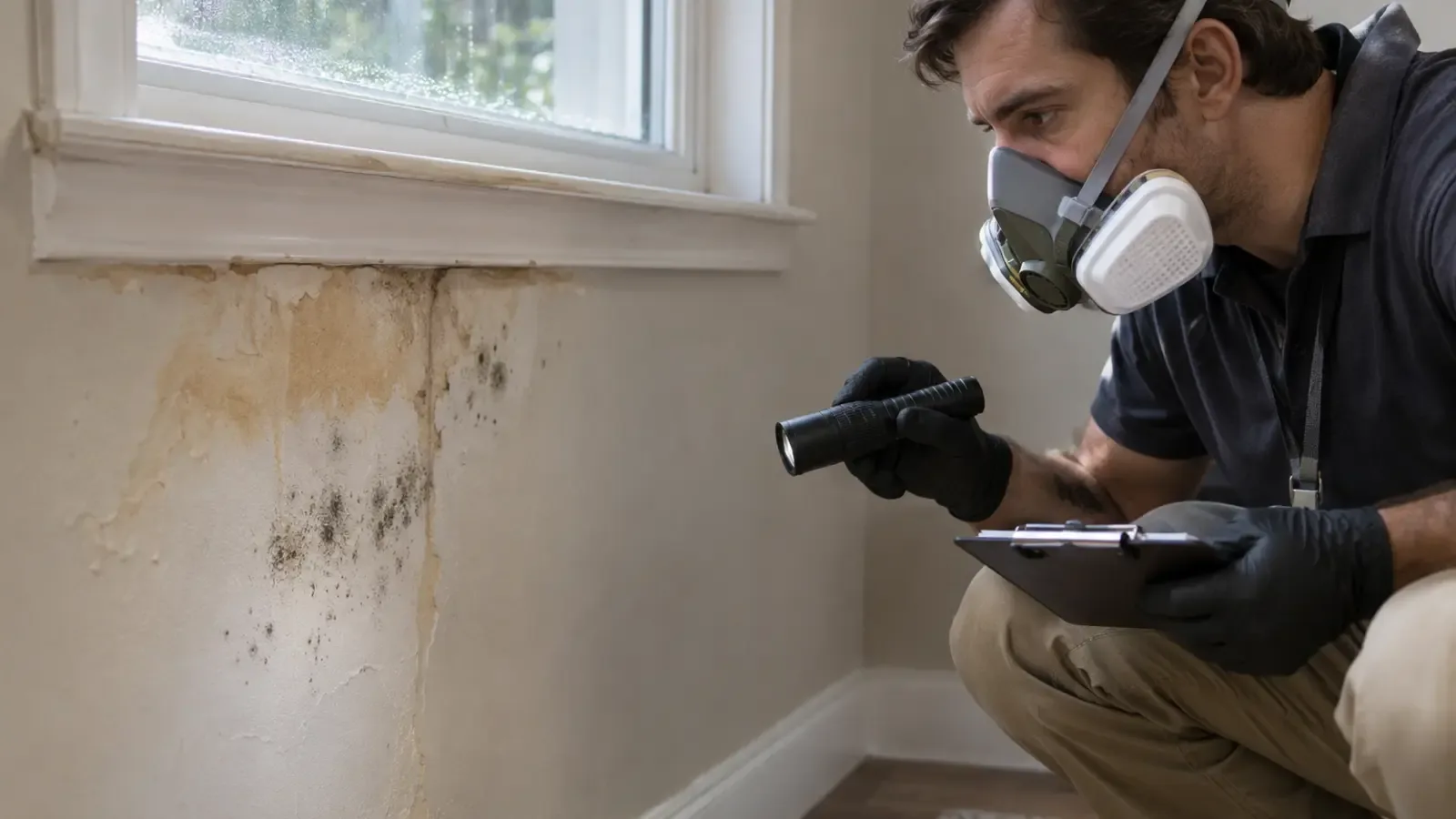
A patch of mold on drywall after a leak may look like a surface problem. Once the stain is covered with primer and paint, however, the wall can appear repaired even though no one has confirmed where the water entered, how far it traveled, or what remains affected behind the finished surface.
The useful question is not simply whether the spot can be covered. It is whether the leak source, moisture path, concealed materials, and condition of the drywall are understood well enough to finish the wall without hiding an unresolved problem.
A Painted Spot Is an Endpoint, Not a Moisture Map
The visible mark may be the place where moisture finally reached the room-facing surface. It does not necessarily identify where the leak began or define the full affected area.
Water from a roof, pipe, window, appliance connection, or air-conditioning drain can enter one part of an assembly and appear somewhere else. Depending on the construction and source, it may move downward through a cavity, follow a material edge, reach insulation, collect behind a baseboard, or affect the opposite side of the wall.
The U.S. Department of Energy describes several ways moisture moves through buildings, including bulk water movement and capillary action.
Painting can make later investigation harder by covering the original stain shape and boundary. Before cosmetic work begins, photograph the spot and note when it appeared, whether it changed, where the odor is strongest, and what happened immediately before it became visible.
Trace the Leak in Four Places Before Choosing a Repair
A useful moisture investigation follows the water rather than treating the darkest mark as the entire problem. These four locations help organize that investigation.
The Source
First, determine where the water entered and whether that source has actually been corrected. A repaired pipe beneath the stain may be the answer, but the source could also be higher in the wall, above the ceiling, around a window, or on the other side of the assembly.
If the source remains active or uncertain, new paint can conceal the next visible warning while water continues reaching the wall.
The Travel Route
Next, consider how water could have moved from the source to the visible spot. Check adjacent trim, floor edges, the opposite side of the wall, nearby cabinets, and the room or level below when appropriate.
Do not cut or drill into a wall casually. Electrical wiring, plumbing, contaminated materials, and concealed mold can change the safety and scope of the work.
The Concealed Reservoir
Insulation, the back paper of drywall, framing, wall plates, and flooring edges can retain moisture outside the painted area. A surface that feels dry does not prove that every concealed layer has dried.
This is one reason a small stain can require a broader assessment. The objective is not to remove extra material automatically. It is to identify which materials were affected and whether they can be accessed, cleaned, and dried adequately.
The Visible Endpoint
Finally, evaluate the drywall where the stain or growth appeared. Look beyond color:
- Is the panel firm and flat?
- Is the paint blistered or separating?
- Is the drywall soft, swollen, sagging, or crumbly?
- Does the spot return after cleaning or repainting?
- Is there an odor even when the surface looks dry?
These observations do not diagnose everything inside the wall, but they help distinguish a cosmetic stain from a material or cavity problem.
What Paint Can and Cannot Resolve
Paint has a legitimate finishing role after the moisture and mold problem has been addressed. It is not a substitute for that work.
Paint Changes the Surface, Not the Conditions Behind It
A stain-blocking primer may prevent an old, resolved water mark from bleeding through a finish coat. It cannot confirm that the leak stopped, remove mold from porous drywall, dry insulation, or establish that the wall cavity is ready to close.
The EPA advises homeowners not to paint or caulk moldy surfaces. Mold should be addressed and the surface dried first because paint applied over mold is likely to peel. EPA guidance also says not to seal or paint materials that remain wet or show biological growth.
A Musty Odor Is a Clue, Not a Diagnosis
A musty smell but no visible mold can indicate concealed dampness or growth, but odor alone does not identify the exact source, location, or material involved. Wet building materials and other conditions can also produce odors.
The CDC’s National Institute for Occupational Safety and Health notes that visual inspection and musty-odor detection can be more useful for finding dampness problems than routine air sampling. A persistent odor after a known leak should therefore prompt a search for the moisture source and affected materials, not an assumption that air freshener, deodorizer, or paint solved it.
Should Moldy Drywall Be Removed?
Not every discolored drywall panel requires automatic removal, but stain size alone is not a dependable decision rule. Drywall mold remediation should account for the material’s condition, the depth of growth, the water source, and what must be accessed behind the panel.
Limited cleaning may be appropriate when growth is genuinely superficial, the painted surface remains intact, the board is firm, the moisture source has been corrected, and the full assembly is dry.
Removal becomes more likely when:
- Mold has reached bare paper, the back of the panel, or the wall cavity.
- The drywall is soft, swollen, delaminated, sagging, or crumbling.
- Wet insulation or other concealed material cannot be accessed and dried.
- Growth or staining returns after cleaning or repainting.
- Sewage, outdoor floodwater, or another contaminated source was involved.
- The affected extent cannot be established from the room-facing surface.
The Florida Department of Health states that removal and replacement may be necessary when moldy material such as drywall, insulation, or carpet padding is not readily cleanable. EPA guidance similarly explains that mold can enter the spaces within porous materials, making complete cleaning difficult.
For a broader discussion of material condition after water exposure, see our guide to deciding whether water-damaged drywall can be saved or should be replaced.
Mold Remediation vs. Mold Removal
These terms overlap, but they do not describe exactly the same scope. Removal is an action. Remediation is the larger process used to resolve the mold and moisture conditions appropriately.
| Scope question | Mold removal | Mold remediation |
| What is addressed? | Affected growth or material | Moisture source and affected environment |
| Is material discarded? | Possibly | When condition and cleanability require it |
| Are work controls considered? | Not defined by the term alone | Yes, according to project conditions |
| Is drying included? | Not necessarily | It is part of resolving the moisture problem |
| Is the result evaluated? | Not implied | The completed condition should be assessed |
The current ANSI/IICRC S520 standard treats professional mold remediation as a procedural project involving inspection, building and material science, safety, structural remediation, documentation, and verification considerations. Removing a piece of drywall may be one part of that process, but it does not by itself resolve the leak or establish that the remaining assembly is dry.
The Finish Line Is a Resolved Wall Assembly
Painting should be the last visible step, not the first response to a suspicious spot. Before finishing the wall, confirm that the source has been corrected, the likely travel route has been investigated, affected materials have been cleaned, dried, or removed as appropriate, and the remaining assembly is sound.
When the leak source or affected area remains unclear, our residential water damage restoration service addresses water extraction, drying, cleanup, and restoration based on the conditions of the loss.
A successful repair does more than make the spot disappear. It explains why the spot appeared and resolves the moisture path that led to it.
Frequently Asked Questions
Can I use stain-blocking primer after a drywall leak?
Yes, but only after the leak has been corrected and the affected materials are clean, dry, and sound. Primer can keep a resolved stain from showing through new paint. It cannot dry a cavity or cover mold as a substitute for cleanup or remediation.
How far can water travel from the visible drywall stain?
There is no reliable fixed distance. The route depends on the source, duration, wall construction, openings, insulation, gravity, and connected materials. Check above, below, beside, and behind the visible spot rather than assuming the stain marks the full boundary.
What does a musty smell with no visible mold mean?
It means further investigation is reasonable, especially after a known leak. The odor may come from concealed mold, damp drywall paper, wet insulation, wood, flooring, or another moisture-affected material. Smell can help locate a problem, but it does not identify the cause by itself.
Should moldy drywall always be removed?
No. A small amount of superficial growth on an intact, dry, painted surface may sometimes be cleanable. Removal is more likely when growth penetrates the paper, reaches the back of the panel, returns after cleaning, or accompanies softness, swelling, contamination, or inaccessible wet materials.
Do I need mold testing before opening a wall?
Not automatically. The CDC does not recommend routine mold testing in most home situations, and a negative short-term air sample does not prove that a concealed cavity is unaffected. Testing may be appropriate for a specific professional question, but it should not delay correcting a known leak or addressing visible growth.
Does mold-resistant paint kill existing mold?
Mold-resistant paint is intended to resist future growth on an appropriately prepared surface. It does not make existing mold, contaminated drywall, or hidden moisture acceptable to cover. Cleanup, drying, and any necessary removal come first.
Who should investigate a painted-over leak spot?
The source determines who may be needed. A plumber, roofer, HVAC contractor, window specialist, restoration provider, or mold professional may each address a different part of the problem. A useful scope should identify who corrects the source, who evaluates affected materials, and who performs the final repair.
What changes if sewage or outdoor floodwater reached the drywall?
Contamination changes the cleanup and material decisions. Avoid opening or demolishing contaminated porous materials without appropriate controls. Florida health guidance recommends experienced professional help when sewage or other contaminated water caused the mold or water damage.