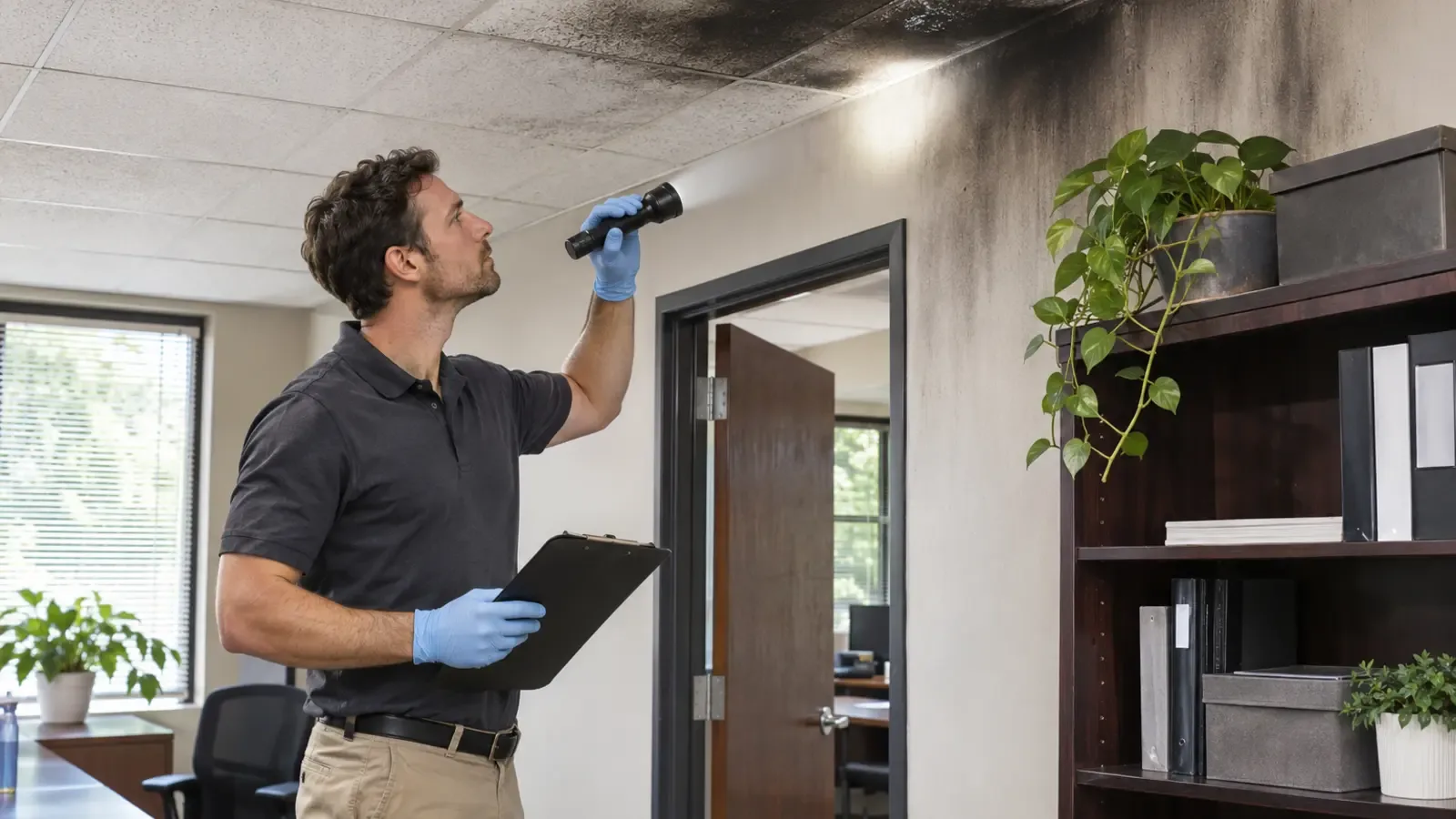
A fire can be small enough to extinguish quickly and still create a complicated reopening decision. Smoke may travel beyond the burned room, soot can settle on merchandise and equipment, and extinguisher residue or firefighting water can create a second cleanup scope.
For a retailer or office manager, the key question is not simply, “Is the soot gone?” It is whether the affected area, building systems, contents, and required approvals have each been addressed. Commercial soot removal is one part of reopening, not the only test.
A Small Fire Can Create a Building-Wide Reopening Question
Fire size and residue spread are not the same thing. A wastebasket, appliance, or back-room fire may produce smoke that moves through open doors, ceiling voids, return-air paths, or a shared HVAC system before the flames are controlled.
That is why a clean-looking burn area does not establish that the rest of the business is ready. The current ANSI/IICRC S700 standard describes professional assessment as considering fire residues and odors across the building, HVAC, and contents. It also treats documentation and the requirements of authorities having jurisdiction as part of the restoration framework.
Use Five Separate Checks Before Setting a Reopening Time
Treat reopening as a set of decisions with different owners. A restorer can document cleaning, but that does not replace an electrician’s evaluation, an HVAC assessment, or a required decision by the local authority.
| Reopening check | Question to resolve | Useful evidence |
| Occupancy and life safety | Has the appropriate official or building representative allowed entry and occupancy, and are exits, alarms, suppression systems, and utilities ready? | Written instructions, inspection records, system service records |
| Residue boundaries | Where did soot, smoke odor, extinguisher agent, and suppression water actually travel? | Room-by-room assessment, HVAC review, photographs, work scope |
| Building systems | Can HVAC, electrical, data, and fire-protection systems be returned to service? | Qualified trade evaluations, filter or component records, functional checks |
| Contents | Which merchandise, furnishings, documents, and devices can be cleaned, held, tested, or discarded? | Itemized inventory, disposition log, insurer or regulator direction |
| Cleaning verification | Does the completed work match the agreed scope, including areas outside the burn room? | Completion report, visual inspection, targeted testing when justified, unresolved-item list |
Do not combine these into one vague “all clear.” Assign each check to a named decision-maker and record the evidence still needed. This makes phased reopening easier to evaluate without implying that an unaffected zone is ready simply because it is separated by a door.
Check What Moved Beyond the Burn Area
The first cleaning plan should follow the path of residue, not the edge of the visible scorch mark. Smoke, soot, water, and suppression agents may have different boundaries.
Air Paths and HVAC Components
Determine whether the HVAC operated during or after the fire and whether affected rooms share returns, supply ducts, ceiling plenums, or air-handling equipment. Do not restart a system merely to see whether the odor returns.
FEMA smoke-remediation guidance cautions against running an air handler before bulk soot or ash is removed. EPA guidance notes that duct cleaning should be based on need rather than ordered automatically.
An HVAC review may involve filters, registers, accessible components, airflow paths, and the manufacturer’s operating requirements. OSHA also notes that there is no single test that resolves every workplace indoor-air-quality concern. The verification method should match the suspected source and system.
Walls, Ceilings, and Less-Visible Surfaces
Soot on walls after a fire can be only the most obvious deposit. Check the tops of partitions, shelving, ceiling tiles, light fixtures, closets, stockrooms, and surfaces near returns or door gaps. Photograph conditions before anyone wipes or paints them.
Avoid making “deep-clean soot” a single instruction for every finish. Residue and surface type affect the method. Aggressive rubbing or adding liquid too early can smear loose residue or damage paint. A test area and a material-specific cleaning sequence help determine whether a finish can be cleaned, must be sealed and refinished, or needs replacement.
Suppression Residue and Water
Identify what extinguished the fire. Water, dry chemical, wet chemical, and other agents leave different follow-up needs. Also trace water under flooring, into wall assemblies, or around electrical equipment. These are separate conditions from soot and may require drying, corrosion review, or qualified trade work before the space returns to service.
Make Separate Decisions for Stock, Equipment, and Records
A surface-cleaning scope cannot answer every contents question. Retail inventory and office assets need an item-level or category-level disposition process.
Merchandise and Food Products
Segregate affected goods before cleaning traffic spreads residue into unaffected stock. Consider packaging, porosity, heat, smoke, suppression chemicals, water, odor, and any temperature loss. Do not assume a sealed-looking package protected its contents.
Food retail has an additional regulatory track. The Florida Department of Agriculture and Consumer Services regulates many grocery, convenience, bakery, and similar retail food operations. Its emergency resources direct operators to work with the appropriate regulatory authority, and recovery guidance may require approval before operations resume.
Ordinary nonfood retail should not borrow food rules blindly, but consumables, cosmetics, medicines, and other sensitive goods may still require manufacturer, insurer, or regulator input.
Electronics and Office Assets
Computers, point-of-sale equipment, printers, network hardware, and controls can appear normal while carrying deposited residue. NIST’s review of fire smoke and electrical equipment identifies soot deposition, corrosion, and current leakage as potential failure mechanisms, while also noting there is no universal rule that predicts whether exposed equipment will survive.
Keep suspect equipment out of service until its disposition is established. Record the model, location, condition, and exposure category, then route the decision to the appropriate equipment specialist, electrician, manufacturer, insurer, or data-recovery provider. Do not use a cosmetic wipe-down as an electrical clearance.
Define What Finished Cleanup Must Prove
Before work starts, write acceptance points that match the actual damage map. This turns “clean up soot after fire” from an open-ended request into a verifiable scope.
A useful completion review checks that:
- Source debris and non-salvageable materials were handled under the approved scope.
- Identified hard and soft surfaces were cleaned with methods suitable for those materials.
- Affected HVAC areas and filters were evaluated and addressed as required.
- Water or suppression residue was not left as an unresolved secondary problem.
- Inventory and equipment decisions were documented rather than assumed.
- Cleaned areas were protected from recontamination.
- Remaining odor, staining, damage, or access limitations were recorded.
Visual inspection is essential, but it is not automatically the only verification. Targeted sampling or air measurements may be appropriate when a qualified assessor identifies a specific question they can answer. Testing should not be added simply to produce a reassuring number, and an odor-masking treatment should not substitute for residue removal.
Coordinate Tallahassee Reopening Checks Early
For soot cleanup in Tallahassee, ask the responsible officials and property stakeholders what they require before cleaning is finalized. The Tallahassee Fire Department Prevention Division oversees business inspections in the city and Leon County, while Florida’s fire code is enforced by the local fire official.
Whether a post-incident inspection, permit, or other approval applies depends on the damage, repairs, systems involved, and type of occupancy.
Contact the landlord or property manager, insurer, fire-protection vendor, and any applicable food or occupational regulator early. Ask each party what documentation they expect and who can authorize the relevant decision.
If commercial fire and smoke damage extends beyond routine janitorial cleaning, our smoke damage and odor control service is a relevant starting point for discussing the cleanup scope. Confirm the property address and service fit when you call.
Reopen by Evidence, Not by the Size of the Fire
A small fire does not need an oversized response, but it does need the right response. Reopening is defensible when the damage boundary has been assessed, systems and contents have been routed to the right decision-makers, cleanup has been verified against a written scope, and required authorities have released the areas they control.
“The room looks clean” is an observation. It is not the complete reopening standard.
Frequently Asked Questions
Can an Office Reopen if Soot Was Limited to One Room?
Possibly, but a closed door is not enough evidence. Confirm whether smoke or residue moved through shared HVAC, ceiling spaces, corridors, or cleaning traffic. A phased reopening may be reasonable only after the unaffected area, access route, utilities, life-safety systems, and separation plan have been evaluated by the responsible parties.
Does a Smoke Odor Mean Soot Is Still Present?
Odor can signal a remaining source, residue in porous materials, or contamination in an overlooked area, but odor alone does not identify the location or concentration. Investigate the source before adding fragrance or deodorization. The absence of odor also does not prove that every surface or device is clean.
Should HVAC Ducts Always Be Cleaned After a Small Fire?
No. EPA guidance recommends duct cleaning based on conditions, such as excessive debris or particles being released from registers, rather than as an automatic step. The assessment should consider whether the system ran, which zones it served, what reached accessible components, filter condition, and HVAC manufacturer requirements.
Can Smoke-Exposed Retail Merchandise Be Cleaned and Sold?
There is no single answer for all inventory. Packaging, product type, heat, residue, odor, water, and applicable rules matter. Segregate affected stock and document it before deciding. Food and other sensitive products may need regulator, manufacturer, or insurer direction, while some durable nonporous goods may be candidates for evaluated cleaning.
Is Repainting Enough When There Is Soot on Walls After a Fire?
Not by itself. Painting over unremoved residue can leave contamination or odor beneath the coating and may lead to staining or adhesion problems. The surface should first be assessed and cleaned using a method compatible with the finish. Sealing, repainting, or replacement comes after the residue and substrate condition are understood.
Do Employees Need Respirators to Help Clean Up Soot After a Fire?
Do not hand out respirators as a substitute for a workplace hazard assessment. OSHA requires employers to assess hazards and use appropriate controls and protective equipment. When respirators are required, selection, medical evaluation, fit testing, training, and program requirements may apply. Keep ordinary staff out of the cleanup zone unless their work has been properly assessed and controlled.
What Documentation Should a Business Keep Before Reopening?
Keep pre-cleaning photographs, the fire or incident information available to you, affected-area maps, inventories, disposal decisions, invoices, equipment evaluations, system service records, cleaning scopes, completion reports, and written instructions from officials or regulators. Also record unresolved conditions and the person responsible for each next step.