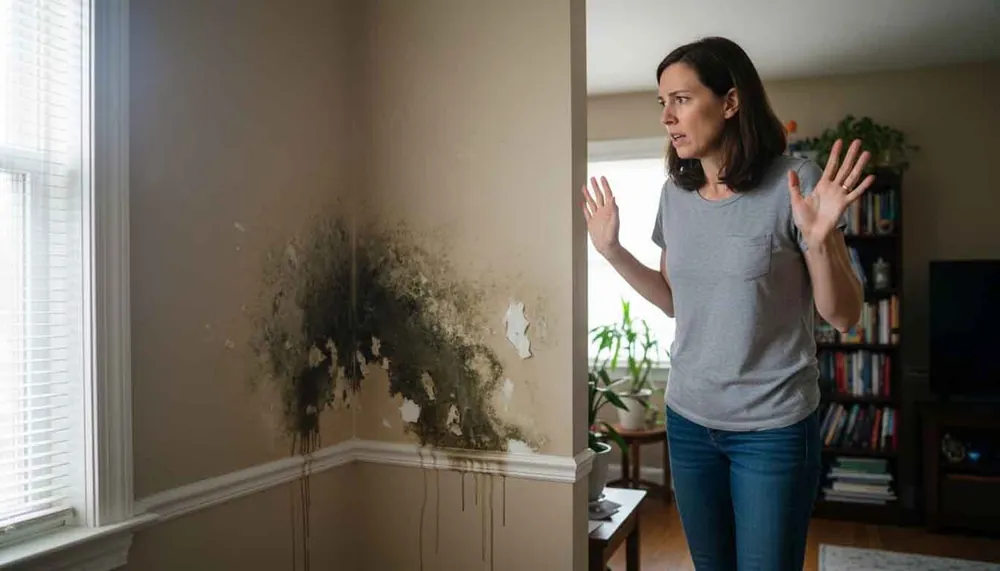
Mold prevention is not really about fighting mold spores. They are already part of the environment, and there is no practical way to remove every spore from an indoor space.
The part you can control is moisture.
That makes prevention easier to think about as a chain. Water gets into or forms inside the property, materials stay wet, moisture moves somewhere less visible, and the same condition repeats.
Break that chain early enough, and you reduce the conditions that allow indoor mold growth.
Think in Moisture Events, Not Mold Spots
Waiting for visible mold means moisture has already had time to become a building-material problem.
A better prevention plan follows what happens before growth becomes the obvious clue:
Water enters → materials stay wet → moisture becomes hidden → the same area gets wet again.
EPA guidance makes the same underlying point: moisture control is the key to controlling indoor mold, and water-damaged materials should be dried quickly.
The five steps below are designed around breaking that moisture cycle.
5 Ways to Break the Moisture Cycle
1. Stop Water at the Entry Point
Do not make the visible wet spot the entire investigation.
A damp baseboard could trace back to a plumbing connection, window, roof detail, exterior drainage problem, or HVAC condensate issue. Water beside a cabinet may have traveled from somewhere else before becoming visible.
When you find unexpected moisture, ask:
- Where could the water have entered?
- What sits above, behind, or beside the wet area?
- Did the problem follow rain, plumbing use, or an HVAC cycle?
- Has the same location been wet before?
Then correct the source rather than repeatedly drying the symptom.
This also applies outside. Roof drainage, gutters, downspouts, and ground drainage matter because preventing water from reaching the building is easier than drying it after it gets inside.
2. Start the Drying Clock Immediately
Once materials get wet, elapsed time matters.
EPA recommends drying wet or damp areas and materials within 24 to 48 hours when possible.
That does not mean merely removing the visible puddle.
Carpet padding, drywall edges, cabinets, insulation, trim, and flooring assemblies can hold moisture after the exposed surface looks better.
After a substantial leak or water event:
- Stop the source if it is safe to do so.
- Remove standing water appropriately.
- Determine which materials absorbed water.
- Keep checking the affected area after the obvious water is gone.
Our first 60 minutes after water damage guide covers the immediate response when a leak or water event has already occurred.
The important prevention question is not simply, “Did we clean up the water?”
It is, “Did everything that got wet actually dry?”
3. Treat Condensation as a Water Source
Not every moisture problem arrives as a leak.
Water can form directly on cold surfaces when humid air reaches them. That is why condensation on windows, pipes, vents, walls, or other cool surfaces deserves attention even when there is no obvious plumbing failure.
Keep indoor relative humidity below 60 percent where possible, ideally between 30 and 50 percent, and treat recurring condensation as a moisture warning.
Look for patterns:
- Windows that repeatedly collect water.
- Pipes that regularly sweat.
- Dampness near an air handler or vent.
- Closets or corners that feel different from the rest of the room.
- Moisture that appears during long cooling cycles.
Our guide to AC condensation and water-damage clues explains how condensation can move into carpet, baseboards, upholstery, and nearby materials before you ever see a large puddle.
Ventilation, air conditioning, dehumidification, insulation, airflow, and HVAC maintenance can all matter depending on what is producing the condensation.
The first job is figuring out why the surface keeps getting wet.
4. Check What Dries Last
The first surface to look dry is not necessarily the last material to become dry.
This is one of the easiest moisture problems to miss.
Water can move:
- Behind baseboards.
- Beneath carpet into padding.
- Under flooring.
- Into cabinet toe kicks.
- Behind drywall.
- Into ceiling or wall cavities.
- Around plumbing penetrations.
Hidden areas such as walls and other concealed spaces can stay wet even when the most visible area receives attention.
After a leak, use the water path rather than the original puddle as your inspection boundary.
For example, water on carpet may spread into the pad farther than the surface discoloration suggests. A wet cabinet base can affect the wall behind it. A ceiling stain may be several feet away from the point where water entered above.
Mold prevention becomes much more reliable when you follow the materials that are slowest to dry, not just the ones easiest to see.
5. Follow Recurrence Back to the Cause
One wet event can be an accident.
The same wet location appearing repeatedly is a pattern.
Pay closer attention when:
- The same grout line darkens after every few showers.
- One baseboard changes after heavy rain.
- The same closet develops a musty odor during humid weather.
- The carpet beside an air handler repeatedly feels damp.
- A ceiling mark reappears after storms.
- Condensation continually forms on the same wall or pipe.
Document when the condition occurs and what happened immediately beforehand.
That small timeline can help separate plumbing use, rain intrusion, condensation, drainage, or another recurring source.
Repeated cosmetic treatment is not prevention. If the same place repeatedly gets wet, painted over, cleaned, recaulked, or deodorized, the moisture pattern still deserves an explanation.
Use a Moisture Map, Not a Mold Checklist
A simple moisture map makes prevention more useful because it connects what you observe to what should be checked next.
What you noticeWhat it may point toWhat to verifyStain appears after rainRoof, window, flashing, or drainage pathWhere exterior water can enterCarpet edge repeatedly feels dampLeak, condensation, or moisture below the pilePadding, wall edge, subfloor, nearby HVACWindow or pipe keeps sweatingHumidity plus a cold surfaceIndoor humidity, airflow, insulationSame bathroom area stays wetSlow drying, ventilation, plumbing, or seal failureDrying time and adjoining materialsDampness near an air handlerCondensate drainage or HVAC moisturePan, drain line, nearby flooring and wallsCeiling mark keeps returningOngoing water entry aboveRoof, plumbing, HVAC, or upper-floor source
You do not need to inspect every square inch of a property every week.
Focus on places with a moisture history: previous leaks, bathrooms, kitchens, laundry areas, HVAC equipment, exterior-wall rooms, roof penetrations, windows, plumbing fixtures, and spaces affected by earlier storms.
When Prevention Turns Into Remediation
Prevention applies while you are controlling moisture before significant indoor growth develops.
Once visible mold is established, materials remain wet, hidden growth is suspected, or a larger water-loss problem has affected building materials, the question changes.
Smaller visible areas can sometimes be handled differently from larger or more complicated losses, while extensive water damage, larger mold areas, contaminated water, and possible HVAC involvement can require more specialized decisions.
At that point, professional mold remediation may be more appropriate than another prevention tip.
The same principle still applies, though: cleanup without correcting the moisture source leaves the conditions for the problem to return.
Prevention Means Breaking the Pattern Early
You cannot make a property permanently mold-proof.
You can make it much harder for moisture to remain unnoticed long enough to support indoor growth.
The most useful prevention routine is:
Stop water entry → shorten wet time → control condensation → check hidden materials → investigate recurrence.
That approach goes beyond keeping the bathroom fan running or buying a dehumidifier.
It gives you a way to recognize when an ordinary wet spot is becoming a repeating property condition, which is exactly when prevention matters most.
Frequently Asked Questions
Can you completely prevent mold in a property?
You cannot eliminate or prevent every mold spore from indoor air or dust. The practical goal is to prevent indoor growth by controlling moisture and drying wet materials promptly.
What indoor humidity helps reduce mold risk?
Keeping indoor relative humidity below 60 percent where possible, ideally between 30 and 50 percent. Condensation can still occur on particularly cold surfaces, so humidity readings should be considered alongside what you actually observe in the property.
How quickly should water damage be dried?
EPA recommends drying wet or damp materials within 24 to 48 hours when possible. The important point is that the affected materials themselves need to dry, not merely the visible surface.
Can mold develop even if the surface looks dry?
Yes. Water can remain in carpet padding, wall cavities, insulation, cabinets, flooring assemblies, and other concealed areas after an exposed surface feels dry. Follow the likely water path after a leak or flood.
Why does mold keep returning to the same place?
Recurring growth often means the area continues to receive moisture or does not dry properly. Look for patterns involving plumbing use, rain, condensation, HVAC operation, ventilation, or damaged materials instead of repeatedly treating only the visible surface.
When should prevention give way to mold remediation?
Consider a broader remediation decision when visible growth is extensive, moisture keeps returning, affected materials cannot be dried or cleaned appropriately, hidden growth is suspected, or a significant water-loss event creates a larger problem. The moisture source still needs to be corrected as part of that process.